What Are J Hooks: Types, Uses & Installation Guide
You use J hooks, which feature a straight shank and a sharp, inward-pointing tip, to secure live or natural bait. They enable quick penetration during active hook sets.
They demand a forceful, timely strike for reliable hooking and suit aggressive fish species. The hook’s gap width and point angle affect holding power and penetration speed.
Wide gaps help with bulkier bait. Understanding these details guarantees you optimize hook performance and fishing success as you explore deeper insights.
Key Takeaways
- J hooks are fishing hooks shaped like the letter “J” with a straight shank and inward-pointing sharp point for quick penetration.
- They require an active, forceful hook set to effectively catch fish during a strike.
- J hooks work best with live or natural bait and aggressive fish species that strike hard.
- They pose a higher risk of deep hooking and injury compared to circle hooks, affecting catch-and-release survival.
- Versatile and reliable, J hooks suit various bait types but demand proper timing and hook size for effectiveness.
What Is a J Hook and How Does It Work?
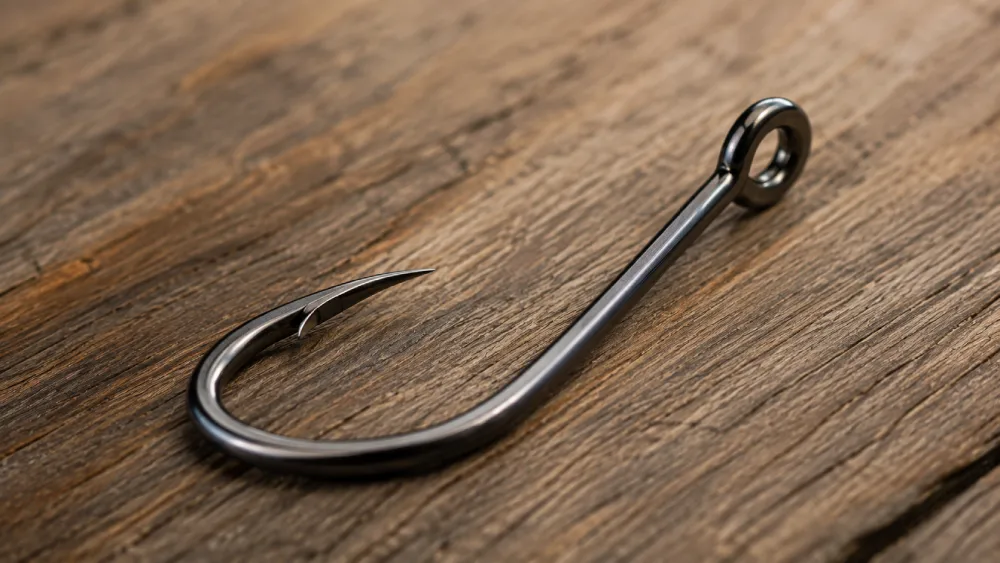
When you pick up a J hook, you’re handling a classic fishing tool shaped distinctly like the letter “J.” This design features a straight shank that shifts smoothly into a curved bend, ending with a sharp point that angles inward toward the shank.
The J hook’s classic shape combines a straight shank and curved bend with a sharp, inward-pointing tip.
The shape facilitates quick penetration when you actively set the hook after detecting a bite. Tension applied during the strike causes the point to catch securely in the fish’s mouth.
You’ll find this design highly effective for live or natural bait, especially when you need a quick, forceful hook set.
Its mechanical simplicity allows for reliable hooking performance, provided you time the set correctly. The J hook’s structure supports a direct, aggressive fishing approach rather than passive hook engagement.
However, compared to circle hooks, J hooks have a higher risk of gut hooking, which can affect catch-and-release survival.
How J Hooks Stack Up Against Circle and Treble Hooks?
When you compare J hooks to circle and treble hooks, you’ll see some pretty clear differences in how they work. These differences can really impact how successful you’re at hooking fish and keeping them on the line.
Now, let’s talk about bait compatibility. J hooks really shine when it comes to natural bait. They just seem to do a better job there. On the other hand, treble hooks are often a better match for lures. So, what you’re fishing with can definitely influence your hook choice.
And don’t forget about conservation! Circle hooks are designed to minimize deep hooking, which makes them a solid option if you’re planning on catch and release. It’s a great way to be mindful of the fish while still enjoying your time on the water.
Unlike circle hooks, J hooks require an active hook set to penetrate effectively, which means you need to lift the rod tip firmly to secure the fish.
Hooking Mechanism Differences
Although all three hook types—J hooks, circle hooks, and treble hooks—serve to secure fish, they differ fundamentally in hooking mechanisms that affect strike response and hook set technique.
J hooks rely on a direct, forceful hook set. You must actively wind down on the line to drive the sharp point into the fish’s mouth.
Circle hooks, by contrast, are designed to hook passively. They slide toward the mouth’s corner as tension is maintained, eliminating the need for a hard set.
Treble hooks, with three points, increase hooking probability on contact but don’t require precise timing.
As an angler, you’ll find J hooks demand quicker reaction and deliberate setting. Circle and treble hooks offer more passive or contact-based hooking, influencing your strike strategy accordingly.
In addition, the choice of knot, such as the Palomar knot or Snell knot, can influence the strength and presentation of your hook setup, affecting overall fishing success.
Bait Compatibility Comparison
Bait compatibility plays a critical role in selecting the appropriate hook type for your fishing method.
J hooks excel with natural and live bait, as their straight shank allows secure bait attachment and quick penetration during hook sets. Compared to circle hooks, J hooks require active angler involvement to set the hook, making them better suited for aggressive fish that strike hard.
Circle hooks, designed to slide to the mouth’s corner, often work better with passive bait presentations and reduce deep hooking risks.
Treble hooks, having multiple points, enhance hooking probability with artificial lures but are less ideal for natural bait due to difficulty in baiting and increased injury potential.
Ultimately, your choice depends on bait type, target species, and whether you prefer active hook setting or passive hooking techniques. For optimal fishing success, also consider the bait compatibility properties of your fishing line to match your hook and bait selection.
Conservation and Usage Impact
Understanding the conservation and usage impact of J hooks requires examining how their design influences fish injury and handling compared to circle and treble hooks.
Unlike circle hooks, which often hook fish in the mouth corner and reduce deep hooking, J hooks increase the risk of gut hooking due to their straight-point design and active hook-setting requirement. This can elevate mortality rates, particularly in catch-and-release scenarios.
Treble hooks, with three points, exacerbate tissue damage and complicate hook removal, raising injury severity. However, J hooks offer quicker penetration and reliable hookups, benefiting certain aggressive fishing techniques.
When conservation is a priority, you might favor circle hooks for their lower injury profile. Still, if you prioritize immediate hook sets and bait types, J hooks remain effective despite their higher potential for harm.
Proper fish handling techniques can help mitigate injury and improve survival, regardless of hook type.
When Should You Use J Hooks?
When you need a reliable hook that enables a quick, forceful set, J hooks are your go-to choice.
For a dependable hook that delivers fast, powerful sets, choose J hooks every time.
You should use J hooks when your fishing style demands rapid hook penetration, especially with live or natural bait.
They excel in scenarios where aggressive fish strike fast, requiring immediate action.
Consider J hooks if your technique involves active bait presentations that rely on a deliberate hook set rather than passive hooking.
Use J hooks when:
- Targeting aggressive fish species that require quick hook sets.
- Employing live or natural bait that suits direct penetration.
- Fishing methods allow you to detect bites and react swiftly.
- You prefer a classic, versatile hook shape compatible with various baits.
This strategic approach maximizes your hookup efficiency while acknowledging J hooks’ operational requirements.
Proper hook selection also involves matching hook size to target species to ensure effective hook sets and minimize damage to the bait, as detailed in Choosing Hooks.
Which Fish Bite Best on J Hooks?
Certain fish species respond more effectively to J hooks due to their feeding behaviors and strike patterns. Predatory and aggressive feeders like tuna and mahi prefer quick, forceful bites, making J hooks ideal for rapid hook sets.
Similarly, species such as tautog and winter flounder, which exhibit targeted strikes on natural bait, respond well to J hooks’ sharp, inward-pointing design. You’ll find J hooks excel when fish aggressively engulf live or natural bait, allowing you to capitalize on their immediate reaction.
However, slower feeders or species with delicate mouths may not suit J hooks as well, given the need for a decisive hook set. Understanding these behavioral nuances helps you select J hooks effectively, optimizing your catch rate on species with rapid, assertive strike dynamics.
For targeting large offshore species like tuna, pairing J hooks with durable, fast-action rods designed for heavy lines can enhance hook setting and control during the fight, especially when using rods with fast action power.
How to Set Your J Hook for a Great Catch?
Mastering the timing and technique of setting your J hook is essential for securing a reliable catch. When a fish bites, you need to react swiftly to guarantee the hook penetrates properly.
Unlike circle hooks, J hooks require a deliberate, forceful hook set. Focus on these key steps:
Maintain tension on the line to detect the bite immediately.
Once you feel a bite, quickly lower the rod tip to reduce slack.
Execute a firm, sharp upward or sideways jerk to drive the hook into the fish’s mouth.
Avoid excessive force that might tear the hook free or damage the bait presentation.
For best results, ensure your hook is securely tied using a reliable fishing knot before casting.
Advantages and Drawbacks of J Hooks
Executing a proper hook set with a J hook highlights both its strengths and weaknesses in fishing scenarios. You benefit from its versatile design, which adapts to various bait types and aggressive fish strikes.
The sharp inward-facing point enables quick penetration when you apply tension, making it ideal for active fishing techniques requiring a deliberate hook set. However, you must recognize its drawbacks.
J hooks have a higher risk of deep hooking, especially if fish swallow the bait before you react. This can lead to increased harm and complicate catch-and-release efforts.
Additionally, the effectiveness of a J hook depends heavily on your timing and fishing style. While it excels in certain contexts, it’s not universally optimal, demanding careful consideration of target species and bait presentation.
For example, using a medium-heavy rod and strong hooks suited to your bait size can enhance hookset success and overall fishing performance.
Choosing the Right J Hook Size and Style
When it comes to choosing the right J hook size, it’s really important to match it to the species you’re targeting and the type of bait you’ll be using. This way, you can ensure those ideal hook sets.
Now, let’s talk about hook styles. Whether you go for a standard, wide-gap, or any other variant, the style you choose can really impact how well the hook penetrates and holds onto the fish.
Selecting a hook with the proper wide gap is crucial to prevent bait crowding and improve penetration efficiency.
Matching Hook Size
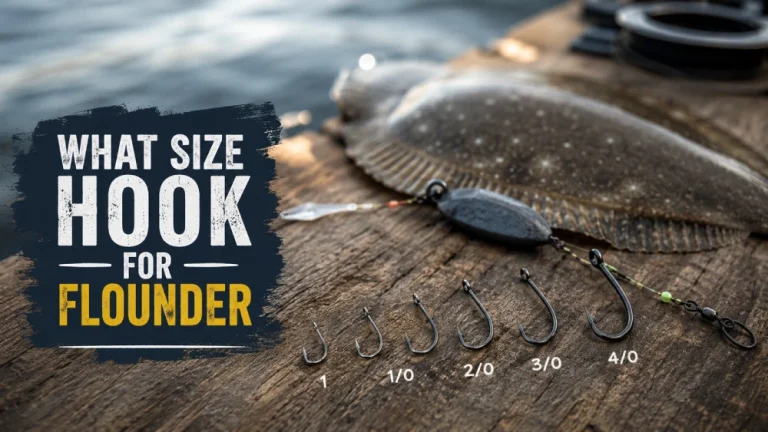
Selecting the right J hook size and style hinges on matching the hook to your bait, target species, and fishing technique. Choosing a hook too large can reduce bait presentation effectiveness, while too small a hook risks poor penetration and lost fish.
Consider these factors when matching hook size:
Bait size: Larger bait requires bigger hooks to secure and present naturally.
Target species: Match hook size to mouth size and fighting behavior for ideal hook sets.
Fishing technique: Active techniques demand quicker penetration, favoring appropriate hook gap and point size.
Hook strength: Larger species need hooks with sufficient wire gauge to withstand force without bending.
Selecting Hook Style
When narrowing down the ideal J hook style, focus on how the hook’s shape and design complement your bait and fishing method.
Choose a hook with a straight shank if you’re using live or natural bait that requires secure placement.
Opt for a slightly wider gap when targeting fish with larger mouths or using bulkier bait to ensure proper hook exposure.
The bend radius also matters: a tighter curve increases hook penetration speed but may reduce holding power.
A more open bend offers better retention.
Consider the point angle too. Sharper points penetrate quickly but can increase deep hooking risk.
Selecting a style that balances these factors enhances your hook set efficiency and bait presentation.
This guarantees the J hook functions at its best within your specific fishing strategy.
Considering Target Species
Understanding the target species plays a critical role in determining the appropriate J hook size and style for your fishing setup. Different fish have varying mouth sizes, feeding behaviors, and strike patterns, which influence your hook choice.
For example, larger predatory fish require bigger, stronger hooks to withstand their power. Smaller species need proportionate, more delicate hooks for effective penetration without damage.
Consider these factors when selecting your J hook:
- Mouth size and anatomy of the species
- Aggressiveness and strike speed
- Typical bait type and presentation method
- Conservation concerns regarding deep hooking risks
Frequently Asked Questions
Can J Hooks Be Safely Used for Catch and Release Fishing?
You can use J hooks for catch and release, but you need to be cautious.
J hooks often cause deeper hooking, increasing injury risk and reducing fish survival rates.
To minimize harm, you should use barbless versions and carefully remove the hook quickly.
If the fish swallows the hook deeply, cutting the line instead of forcing removal is better.
Consider species and fishing conditions to decide if J hooks suit your release goals.
How Do You Remove a Deeply Hooked J Hook From a Fish?
To remove a deeply hooked J hook, first calm the fish and keep it wet.
Use long, narrow needle-nose pliers to grasp the bend of the hook firmly.
Gently back the hook out the same way it entered, avoiding excessive force to reduce tissue damage.
If the hook is deeply swallowed and can’t be removed safely, consider cutting the hook’s shank inside the fish to minimize injury and increase survival chances.
Are J Hooks Suitable for Ice Fishing or Only Open Water?
You can absolutely use J hooks for ice fishing; they’re not just for open water!
Their quick penetration and versatility make them effective through the ice, especially with live or natural bait.
Just remember, ice fishing demands precise hook sets because fish bites can be subtle under cold conditions.
While J hooks excel in active presentations, you’ll need steady timing and sensitivity to succeed beneath the frozen surface.
What Materials Are J Hooks Typically Made From?
J hooks are typically made from high-carbon steel or stainless steel, offering strength and corrosion resistance essential for durability.
High-carbon steel provides sharpness and toughness but may require protective coatings like nickel or black oxide to prevent rust.
Stainless steel resists corrosion better, ideal for saltwater fishing.
Some J hooks feature coatings such as tin or tin-nickel blends to enhance longevity and reduce visibility underwater, optimizing performance in various fishing environments.
How Does Water Type (Saltwater Vs Freshwater) Affect J Hook Performance?
Saltwater’s corrosive nature demands you use J hooks made from corrosion-resistant materials like stainless steel or coated alloys to maintain sharpness and strength.
Freshwater environments are less harsh, allowing standard carbon steel hooks to perform well without rapid degradation.
Additionally, saltwater fish often require heavier-duty hooks due to their size and strength. You should select larger, stronger J hooks for saltwater, while freshwater fishing typically involves lighter, more delicate hook options.
J Hook Sizes: Finding the Right Match for Your Target Fish
When you choose a J hook, you’re wielding a precision tool, like a scalpel in your fishing kit. It’s designed for control and efficiency.
Its simple yet effective design cuts through water resistance, offering a strong hold without unnecessary complexity.
By understanding its strengths and limits, you’ll match the right size and style to your target fish.
This ensures every cast is a calculated strike rather than a blind gamble.
Master the J hook, and you master the art of strategic angling.