Wet Fly Vs Nymph: Which Fly Catches More Fish?
You’ll want to choose wet flies when trout feed just below the surface or mid-water. Their soft hackles and neutral buoyancy mimic emerging insects drifting in slower currents.
Nymphs, with added weight and streamlined profiles, excel in fast or deep water. They are effective for reaching trout feeding on the riverbed.
Mastering when to switch between these based on flow, depth, and fish behavior sharpens your approach. Understanding their role can markedly improve your hook-up rates.

- Well-Made Flies Kit: All fly fishing lures are hand-tied by professionals. The flies are tied with…
- Widely Applied: Multiple types of flies are available. The fly fishing flies assortment kit includes…
- Life-like Flies: Colorful and lifelike hand-tied flies. Fly fishing lures increase the chances of…

- EFFECTIVE FISH-CATCHING FLIES – These flys are effective because Tungsten Bead Perdigon sinks…
- MUST-HAVE FOR FAST WATER – the perdigons are specifically designed to get down to the stream bed in…
- 36 FLIES TOTAL – Hook Size: #14, #16, #18, each pattern 3pcs
Key Takeaways
- Wet flies imitate emerging aquatic insects just below the surface, while nymphs mimic underwater insect larvae on or near the riverbed.
- Wet flies have softer, fuller profiles with soft hackles and no added weight; nymphs are slimmer, weighted, and designed to sink rapidly.
- Use wet flies in slower currents or shallow riffles targeting mid-water feeding trout; nymphs excel in fast flows or deep pools near the bottom.
- Wet flies are fished with a downstream swing on a tight line to simulate drifting emergers; nymphs require an upstream dead drift for natural movement.
- Strike detection differs: wet flies often yield immediate, sharp pulls during swings; nymphs need precise line control for subtle, often lighter takes.
Wet Fly vs Nymph: Complete Side-by-Side Comparison
| Feature | Wet Fly | Nymph |
|---|---|---|
| Imitates | Emerging or drifting aquatic insects | Underwater insect larvae |
| Fishing Depth | Just below the surface to mid-water | Near the riverbed |
| Body Profile | Fuller with soft hackles | Slim, segmented, grub-like body |
| Weight | Usually unweighted | Often weighted with beads or wire |
| Sink Rate | Slow | Fast |
| Best Water Conditions | Slow currents and shallow riffles | Fast currents and deep pools |
| Presentation | Downstream swing on a tight line | Upstream dead drift |
| Buoyancy | Neutral | Negative (sinks quickly) |
| Strike Detection | Sharp, aggressive takes | Subtle line pauses or twitches |
| Trout Feeding Zone | Mid-water and emerging insects | Bottom-feeding trout |
| Ease of Fishing | Easier for beginners | Requires better line control |
| Best Season | During insect hatches | Year-round, especially when fish feed deep |
| Typical Fly Patterns | March Brown Spider, Black Spider, Partridge & Orange | Pheasant Tail, Hare’s Ear, Perdigon |
| Best For | Active trout feeding near the surface | Trout feeding close to the bottom |
| Versatility | Excellent during hatches | Excellent in most water conditions |
| Main Advantage | Natural movement and exciting strikes | Reaches the primary feeding zone quickly |
| Main Drawback | Less effective in deep or fast water | More technical presentation required |
What Are Wet Flies and How They Work?
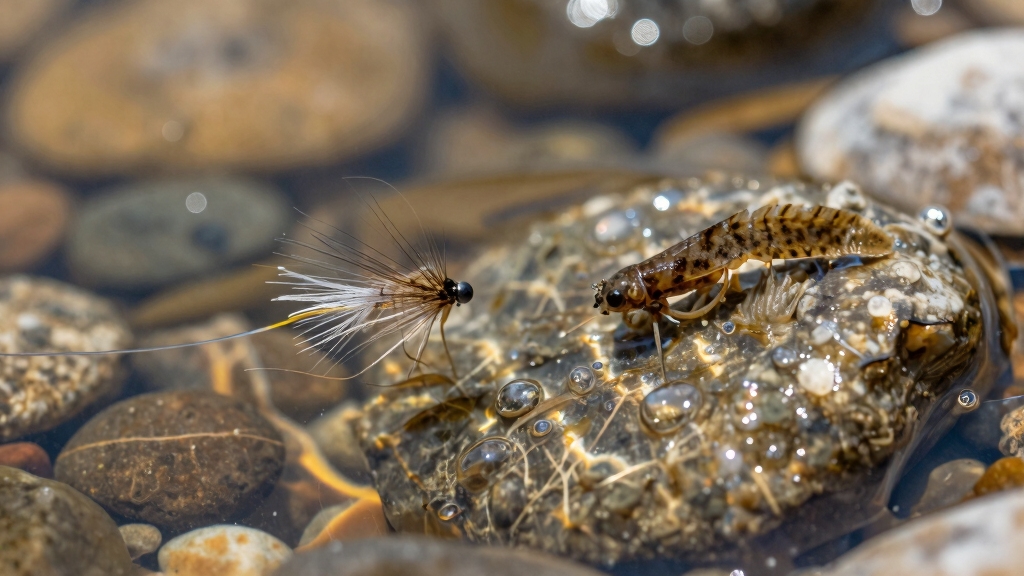
A wet fly is a type of artificial fly designed to sink below the water’s surface and imitate emerging or drifting aquatic insects.
A wet fly mimics aquatic insects just below the surface, enticing fish with natural underwater movement.
When you use wet flies, you rely on their soft hackles and subtle wings to mimic natural insect movement just beneath the film.
You’ll often fish them swung across the current on a tight line, allowing the fly to drift naturally.
Unlike nymphs, wet flies maintain neutral buoyancy and lack weight additions, so they don’t plummet to the bottom but hover in mid-water.
Their profile is less rigid and more lifelike in motion, which can trick trout feeding on emerging insects.
Understanding this helps you effectively present wet flies in gentle currents and shallow riffles where fish feed below the surface.
Additionally, selecting the correct shaft length and mount can enhance presentation and control when using wet flies from a boat or kayak.
Choosing Between Wet Flies and Nymphs for Trout Fishing
Now that you understand how wet flies mimic emerging insects just beneath the surface, selecting between wet flies and nymphs depends largely on the water conditions and trout feeding behavior.
When trout feed mid-water or just below the surface film in slower currents or shallow riffles, wet flies excel. They’re especially effective when swung downstream on a tight line.
Conversely, if you’re fishing fast flows, deep pools, or targeting trout feeding along the riverbed, nymphs are more effective. Their realistic profile and added weight enable rapid descent.
Your choice should also consider trout activity. If they’re visibly rising or showing surface interest, wet flies are preferable. If feeding is subsurface and subtle, nymphs offer a more natural, precise presentation.
Balancing these factors optimizes your success. Additionally, understanding seasonal water conditions can help determine whether wet flies or nymphs will be more effective at any given time.
Key Features That Define Nymph Flies
Understanding the key features that define nymph flies helps you select patterns that accurately imitate underwater insect larvae, improving your chances of fooling trout.
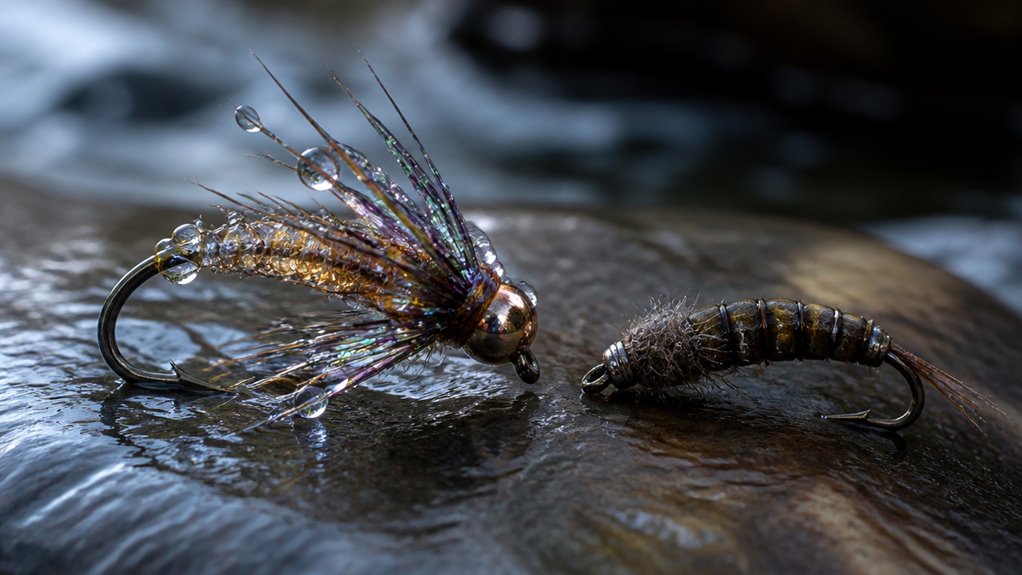
Nymphs emphasize a realistic shape, often grub- or bug-like, with distinct thorax bulges and wing-case details mimicking mayfly, caddis, or stonefly larvae.
You’ll notice added weight, like beads or wire, to guarantee rapid sinking and maintain depth in turbulent currents.
Unlike wet flies, nymphs focus on subdued coloration and streamlined profiles to reflect natural subsurface appearances.
Their construction prioritizes subtle texture over flashy hackles or wings, enhancing underwater realism.
Additionally, many nymph flies feature tungsten beads that provide excellent sinking power, allowing them to reach feeding lanes quickly in fast-moving waters.
Physical Differences Between Wet Flies and Nymphs
Wet flies are pretty interesting! They’ve this fuller, softer profile that really contrasts with nymphs. Instead of being all sleek and streamlined, they’re designed to float just below the surface film, kind of hanging out in that sweet spot.
On the other hand, nymphs are a whole different story. They’ve got that slimmer, grub-like body, which really helps them mimic those larval forms. Plus, their pronounced thorax bulges make them stand out even more. And let’s not forget, nymphs often come with added weight to help them sink quickly. Weighted nymph patterns with tungsten beads are commonly used to ensure rapid sinking to the bottom where fish feed.
Body Shape Comparison
Although both wet flies and nymphs target subsurface feeding trout, their body shapes differ markedly to mimic distinct insect stages.
Wet flies display a more tapered, streamlined profile with less emphasis on thorax bulk. They often feature soft hackles and sparse wings to imitate emerging or drifting insects.
In contrast, nymphs adopt a slimmer, grub-like form, emphasizing a pronounced thorax bulge and realistic wing-case detail to replicate larval stages accurately.
You’ll notice nymphs maintain a compact, bug-like silhouette essential for underwater realism. Wet flies avoid the swept-back wings typical of adults.
This difference in shape directly influences how each fly interacts with water currents and trout perception. Your choice is critical for matching the natural insect stage you intend to imitate.
When organizing your fly collection, consider using a waterproof double-sided fly box to protect and store your wet flies and nymphs efficiently.
Weight and Buoyancy
Weight plays an essential role in how wet flies and nymphs behave underwater. It directly affects their buoyancy and presentation.
Wet flies typically maintain neutral buoyancy, allowing you to fish them just below the surface film. They lack added weight and rely on soft hackles to imitate emerging insects drifting downstream.
Nymphs, in contrast, incorporate beads or lead wire to increase mass. This enables quicker sinking to reach the riverbed where larvae reside.
This added weight guarantees nymphs penetrate turbulent currents and maintain depth, which is important for accurate dead-drift presentations.
When selecting your fly, consider how weight influences the fly’s position in the water column. Wet flies swim midwater with subtle movement, while weighted nymphs sink steadily, imitating underwater insect stages.
Your choice directly impacts how convincingly you mimic natural insect behavior. Using bead-head flies in faster, deeper currents helps nymphs sink quickly and hold the strike zone effectively.
Wet Fly Fishing Techniques and Tips
When you’re out there wet fly fishing, it’s all about how you swing those flies across the current. You want to do this on a tight line to really mimic the way insects drift just below the surface film. It’s kind of like a dance with the water!
Now, the key here is controlling your presentation angle and line tension. Keeping that fly in the feeding zone is crucial if you want to attract those fish. Once you get the hang of these techniques, you’ll find your strike detection improves, and you’ll be imitating those emerging insects like a pro! Using upstream mends can help maintain a natural swing and keep the fly in the strike zone longer.
Swinging Wet Flies
Mastering the swing of wet flies requires understanding how to present the fly just below the surface film, allowing it to drift naturally with the current.
To achieve this, cast slightly downstream and mend your line to maintain a tight, controlled swing across the current. This keeps the fly in the feeding zone longer, simulating emerging or drifting insects.
Use neutrally buoyant flies with soft hackles that pulsate in the water, enhancing realism. Adjust your retrieval speed to match the current, ensuring the fly doesn’t drag unnaturally.
Watch for immediate tight-line strikes, as fish often hook themselves during the swing. Avoid excessive line slack that disrupts the fly’s natural swing path.
With practice, you’ll effectively cover shallow riffles and gentle currents where trout actively feed below the surface.
For improved presentation and control, using Maxima tippets can help maintain stiffness and durability during the swing.
Surface Film Strategies
Frequently overlooked, the surface film plays a critical role in wet fly fishing. It creates a subtle interface where emerging insects linger and trout often feed. Mastering this zone enhances your wet fly presentation. Flies fished just below or within the surface film mimic natural insect emergence more convincingly.
To optimize your surface film strategies, focus on:
Positioning your wet fly to swing just beneath the surface film, avoiding drag that spooks trout.
Using soft hackle patterns that pulsate naturally in the surface tension.
Monitoring water tension and adjusting leader length for precise depth control.
Observing subtle surface disturbances indicating trout feeding zones near the film.
Understanding water currents helps improve positioning and increases the chance of a successful catch.
Nymph Fishing Techniques and Strategies
Employing effective nymph fishing techniques hinges on presenting your fly in a natural drift that mimics underwater insect behavior.
Effective nymph fishing relies on presenting your fly with a natural drift that imitates underwater insects.
You’ll want to achieve a dead drift by casting upstream and allowing the fly to move with the current without drag.
Use weighted nymphs or add split shot to reach the trout’s feeding zone quickly, especially in turbulent or deep water.
Employ long leaders to maintain subtle presentations and detect delicate takes.
Euro-nymphing techniques suit fast-flowing rivers, focusing on controlling slack and maintaining direct contact.
Precise line control and subtle rod tip movement help you feel strikes often missed visually.
Adjust your depth and retrieval speed to match insect activity, ensuring your nymph convincingly imitates the shape, bulge, and movement of natural larvae below the surface.
Using a properly selected strike indicator can enhance bite detection and improve overall nymph fishing success.
How to Spot Takes on Wet Flies and Nymphs?
Recognizing takes on wet flies and nymphs requires keen observation of line movement and subtle rod tip feedback.
When fishing wet flies, you’ll often feel an immediate tug or see a sharp line pull as fish strike on the swing, allowing quick reaction.
Nymph takes tend to be more delicate, often a slight hesitation, twitch, or subtle line pause demands your attention.
Watch for these key indicators:
- Wet fly: tight line pulls or rod tip dips during downstream swing
- Nymph: subtle line twitches or brief stops in upstream dead drift
- Rod tip: quick, sharp movement for wet flies; slower, nuanced for nymphs
- Line behavior: sudden acceleration on wet flies; hesitation or gentle wiggle for nymphs
Mastering these cues improves hookup rates and sharpens your angling precision.
When and Why Nymphs Work Better in Fast or Deep Water?
Maneuvering fast or deep water demands fishing tactics that assure your fly reaches the strike zone efficiently. Nymphs excel in this environment due to their weighted design and realistic profiles.
Success in fast or deep water hinges on flies that reach the strike zone with precision—nymphs deliver exactly that.
Their slim, grub-like shape and incorporated beads or tungsten weights allow you to achieve rapid sink rates. This places the fly near the riverbed where trout feed.
In turbulent currents, this precision assures your nymph isn’t swept away prematurely, maintaining a natural drift. Additionally, the detailed thorax bulge and segmented wing cases imitate underwater larval stages, increasing strike probability.
You’ll find wet flies less effective here, as their neutral buoyancy and surface proximity hinder depth control. When you target subsurface feeding fish in swift or deep flows, nymphs provide the technical advantage by combining weight, shape, and presentation to outmatch wet flies.
Top Wet Fly and Nymph Patterns to Try
If you’re looking to get started with wet flies, classic patterns like the March Brown Spider and Black Spider are fantastic choices. They really do a great job of imitating those emerging insects just below the surface.
Now, when it comes to nymphs, you can’t go wrong with essentials like the Pheasant Tail and Hare’s Ear. These patterns not only have realistic profiles but also come with weighted designs that help them reach those deeper feeding zones.
Classic Wet Fly Patterns
Classic wet fly patterns consistently prove their worth by imitating emerging or drifting insects with soft hackles and subtle wing representations.
When you fish these flies, you rely on their neutrally buoyant design to drift naturally just below the surface film, enticing trout feeding on emergers.
Their soft hackles create lifelike movement in the current, enhancing realism.
Key classic wet fly patterns to incorporate include:
- March Brown Spider: Emulates mayfly emergers with soft hackle and sparse wings.
- Black Spider: Features a slender body and hackle for imitating various insect stages.
- Snipe & Purple: Combines a dark body with purple highlights to mimic caddisflies.
- Partridge & Orange: A traditional pattern with minimal wings and vibrant thorax.
Mastering these patterns sharpens your mid-water fishing strategy.
Essential Nymph Choices
Although wet flies offer subtle mid-water action, nymph patterns remain indispensable when targeting trout feeding beneath the surface.
You’ll want to focus on key nymphs like the Pheasant Tail, Hare’s Ear, and Perdigon. Each is designed to mimic specific larval stages with realistic thorax bulges and slim profiles.
Incorporate weighted options or bead heads to achieve rapid sinking in turbulent currents. This is essential for reaching trout holding in deeper or faster water.
Pay attention to subtle details like wing-case imitation and accurate coloration to provoke strikes.
Unlike wet flies, nymphs demand precise dead-drift presentation, often upstream, to maintain natural movement.
Mastering these patterns will expand your subsurface arsenal, increasing your effectiveness when trout ignore surface offerings and feed primarily on underwater insects.
Versatile Pattern Applications
When selecting versatile patterns, focus on wet flies like the March Brown Spider and Black Spider. They excel in imitating emerging or drifting insects with their soft hackles and subtle wing profiles.
These wet flies perform best in mid-water presentations, enticing trout feeding below the surface.
For nymphs, opt for patterns like the Pheasant Tail and Hare’s Ear that emphasize realistic thorax bulges and weighted profiles for efficient sinking in turbulent currents.
Try incorporating these top patterns into your fly box for adaptability:
- March Brown Spider (wet fly): imitates emerging mayflies with soft hackle movement
- Black Spider (wet fly): effective in varied water conditions with neutral buoyancy
- Pheasant Tail (nymph): realistic shape and thorax, fast sinking in deep pools
- Hare’s Ear (nymph): versatile larval imitation, weighted for steady drift
These selections cover a range of feeding depths and insect stages.
Switching Between Wet Flies and Nymphs While Fishing
Switching between wet flies and nymphs can sharpen your fishing strategy by matching insect activity and water conditions more precisely.
When water runs swift and deep, nymphs with added weight help you reach the feeding zone quickly, imitating submerged larval stages.
Conversely, wet flies excel in mid-water or shallow riffles, swung downstream to mimic emerging insects.
You’ll want to adjust your presentation accordingly: use a dead drift upstream for nymphs to achieve a natural drift and a tight-line swing for wet flies to trigger instinctive strikes.
Watch your line carefully; nymph takes are subtle, requiring prompt, delicate sets, while wet fly strikes feel immediate.
Switching patterns based on flow, depth, and fish behavior keeps your approach adaptive, increasing hook-up rates and efficiency during varied fishing conditions.
Frequently Asked Questions
Can Wet Flies Be Effectively Used in Saltwater Fishing?
Yes, you can effectively use wet flies in saltwater fishing, especially when targeting species feeding on emerging or drifting baitfish and crustaceans near the surface.
Their soft hackles and neutral buoyancy allow you to present them naturally in shallow, tidal currents.
However, you’ll want to modify patterns with durable materials and larger hooks to withstand saltwater conditions and aggressive fish. This ensures your wet flies remain effective and resilient during saltwater excursions.
What Materials Make the Most Durable Nymph Flies for Rough Conditions?
Over 70% of nymph flies fail after repeated strikes in rough waters, so durability is key. Use tungsten beads for weight and abrasion resistance, coupled with strong 140-denier nylon thread.
Incorporate synthetic dubbing like EP fibers; they resist waterlogging and wear. For wings and thorax, opt for stiffer materials such as CDC feathers or biot fibers.
Reinforce hook shanks with epoxy coatings to prevent damage and maintain fly integrity in harsh conditions.
How Does Water Temperature Affect the Choice Between Wet Flies and Nymphs?
You’ll want to choose nymphs in colder water since trout feed deeper and slower, targeting subsurface larvae.
Warmer water encourages insects to emerge near the surface, making wet flies more effective as they imitate drifting or emerging insects.
Adjust your fly choice based on temperature-driven insect behavior: nymphs for low metabolism and deep feeding in cold, and wet flies for active, mid-water feeding in warm conditions to maximize your catch rate.
Are There Specific Rod or Reel Setups Best for Wet Fly Fishing?
You’ll want a 5-6 weight rod around 9 feet for wet fly fishing. This setup offers delicate presentation and good line control.
Pair it with a smooth, mid-arbor reel that balances the rod’s weight for fatigue-free casting.
Use a floating or lightly sinking line to keep your fly just below the surface. This setup lets you swing wet flies naturally in currents, improving your strike detection and hookup success.
How Do Wind Conditions Influence Wet Fly Versus Nymph Fishing Success?
Wind acts like a mischievous sculptor, reshaping your cast’s precision.
You’ll find wet fly fishing more challenging in strong wind since those delicate, lightly weighted flies struggle to land softly and swing naturally.
Conversely, nymph fishing benefits from wind’s push, helping weighted flies sink quickly and maintain a steady drift.
Adjust your casting angle and leader length accordingly: shorter for wet flies to reduce drag, longer for nymphs to guarantee depth control.
- Well-Made Flies Kit: All fly fishing lures are hand-tied by professionals. The flies are tied with…
- Widely Applied: Multiple types of flies are available. The fly fishing flies assortment kit includes…
- Life-like Flies: Colorful and lifelike hand-tied flies. Fly fishing lures increase the chances of…
- EFFECTIVE FISH-CATCHING FLIES – These flys are effective because Tungsten Bead Perdigon sinks…
- MUST-HAVE FOR FAST WATER – the perdigons are specifically designed to get down to the stream bed in…
- 36 FLIES TOTAL – Hook Size: #14, #16, #18, each pattern 3pcs
Wet Flies and Nymphs Explained: When and How to Use Each
When you fish with nymphs, remember they account for about 80% of a trout’s diet underwater, making them incredibly effective.
Wet flies, meanwhile, mimic emerging insects on or near the surface, offering a different strike zone.
By understanding these distinctions and mastering your technique, you’ll increase your catch rate markedly.
Switching strategically between wet flies and nymphs lets you adapt to water conditions and trout behavior, giving you a technical edge on every cast.
Last update on 2026-10-06 / Affiliate links / Images from Amazon Product Advertising API