Midge Vs Nymph: Key Differences Every Angler Should Know
When choosing between midges and nymphs, focus on their size, shape, and life cycles.
Midges are small, streamlined larvae active year-round, with minimal segmentation and uniform colors. They are ideal for delicate presentations near the surface.
Nymphs are larger, segmented, robust aquatic insects hatching seasonally. They require weighted patterns fished near the bottom.
Your fly selection and technique should match these traits and hatch timing to improve strike rates. Exploring their distinct behaviors and habitats will enhance your fishing strategy.
Key Takeaways
- Midges are small, streamlined aquatic insects active year-round, while nymphs are larger, segmented immature stages of mayflies, caddisflies, and stoneflies with seasonal peaks.
- Midge larvae lack prominent legs and have uniform coloration; nymphs possess visible legs, tails, and varied segmented body colors.
- Midge fly patterns are simple, small (#16–22), and subdued, whereas nymph patterns are larger (#6–26), detailed, and often weighted for depth.
- Midges are fished mid-water column with fine tippets for delicate presentation; nymphs are targeted near the bottom using beadhead or tungsten-weighted flies.
- Midges inhabit slow, deep waters continuously; nymphs concentrate near rocky riffles and emerge seasonally from spring to fall.
Midge and Nymph: Key Differences Explained
Although both midges and nymphs represent immature aquatic insect stages essential to fly fishing, they differ markedly in taxonomy, morphology, and behavior.
Midges belong to the Chironomidae family and feature small, streamlined bodies generally 3-10 mm long.
Nymphs encompass a broader group including mayflies, caddisflies, and stoneflies, exhibiting larger, more robust bodies with pronounced segmentation and appendages.
You’ll find midges active year-round, often forming a U-shape near the water surface during emergence.
In contrast, nymphs show seasonal hatches with spring to fall peaks.
Midges use simpler life stages: larva, pupa, and adult, while nymphs have distinct egg, larval, and pupal phases.
These differences influence how you approach fly selection and fishing techniques, adapting to each insect’s unique ecology and behavior.
Understanding seasonal hatch patterns helps anglers choose the right fly for different times of year and water conditions.
Physical Traits: Size, Shape, and Color of Midges and Nymphs
Understanding the physical traits of midges and nymphs sharpens your ability to identify and imitate these insects effectively.
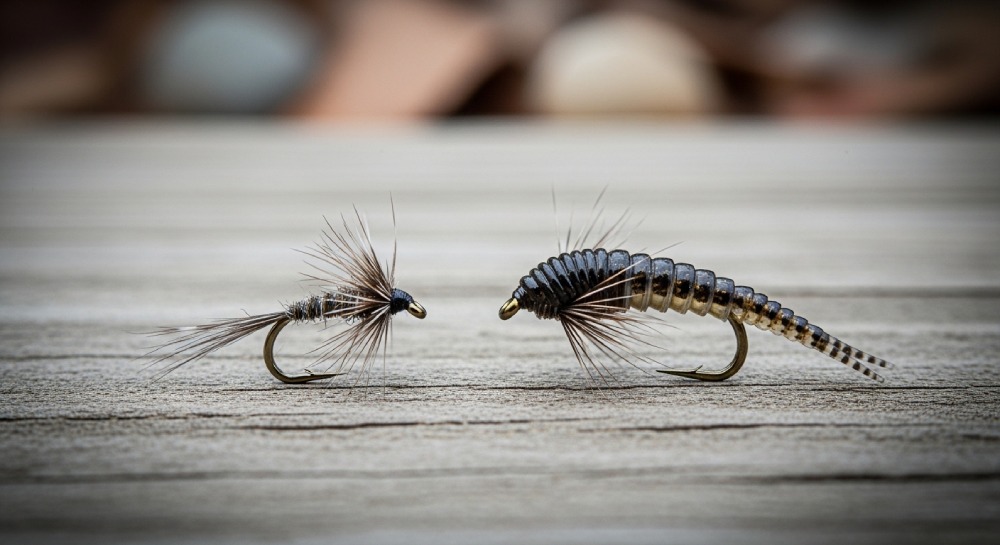
Midges feature smaller, streamlined, elongated bodies measuring 3-10 mm, with minimal segmentation and no prominent front legs. They typically match size 16-22 hooks.
Their coloration ranges from red, brown, gray to black, with red hues resulting from diet, serving uniform camouflage on substrates.
In contrast, nymphs exhibit larger, more robust morphologies with pronounced segmentation, visible legs, and tails, spanning a wider size range from #6 to #26 hooks.
Their coloration varies by species and habitat, often segmented and diverse.
Recognizing these distinct size, shape, and color attributes allows you to select and fish appropriate fly patterns, improving your effectiveness in imitating and targeting midges and nymphs.
Additionally, understanding the difference in body shape and appearance between insects and fish species can enhance your fly fishing success.
Midge and Nymph Life Cycles Compared
When you examine the life cycles of midges and nymphs, you’ll find distinct patterns that influence their availability and behavior in aquatic environments.
Midges undergo a continuous life cycle year-round, progressing through larval (nymph), pupal (emerger), and adult stages. Their pupae carry an air bubble, aiding emergence near the water surface in a characteristic U-shape.
In contrast, nymphs, the immature forms of mayflies, caddisflies, and stoneflies, exhibit seasonal hatches with peak activity from spring to fall. Their life stages include egg, multiple larval instars, and pupal forms before emergence.
Because of these differences, midges maintain a more consistent presence, while nymph populations fluctuate seasonally. This impacts their accessibility to predators and anglers.
Understanding these life cycle dynamics helps you anticipate insect availability and behavior in freshwater systems. Adjusting your fly patterns to match seasonal insect hatches can significantly improve your fishing success.
How to Choose Between Midge and Nymph Flies
The differences in life cycles between midges and nymphs directly influence how anglers select their fly patterns. You’ll choose midge flies when targeting year-round subsurface activity, focusing on small, streamlined imitations in size 16-22 hooks that mimic uniform coloration and subtle movement.
Midge flies match year-round subsurface activity with small, streamlined patterns in sizes 16-22.
Conversely, nymph flies suit seasonal hatches and broader size ranges (#6-26 hooks). These require patterns that replicate segmented bodies, legs, and tails of various aquatic insects.
Consider water depth and emergence timing. Midges emerge underwater near the surface, so fine tippets and delicate presentations work best.
Nymphs reside near the bottom pre-hatch, prompting larger, more complex patterns.
Using the appropriate tippet length enhances presentation and increases your chances of success when fishing midges or nymphs.
Common Fly Patterns for Midges and Nymphs
Anglers frequently rely on specific fly patterns to effectively imitate midges and nymphs, tailoring their selections to the distinct physical and behavioral traits of each insect group.
For midges, you’ll focus on small, streamlined patterns like the Zebra Midge, Griffiths Gnat, and Black Beauty, typically tied on size 16-22 hooks. These flies feature minimal segmentation and subdued colors—black, gray, or red—to mimic larvae’s uniform appearance.
Incorporating beadheads adds subtle flash, simulating pupal air bubbles.
Nymph patterns require more complexity; you’ll choose flies that replicate the robust bodies, pronounced segmentation, and appendages of mayfly, caddis, or stonefly nymphs.
Their sizes vary broadly, from #6 to #26 hooks, and their color patterns reflect species-specific habitat hues. Selecting the right pattern demands attention to these morphological and ecological details.
Additionally, many nymph patterns incorporate tungsten beads to achieve faster sinking and improved presentation in fast-moving waters.
Best Techniques for Fishing Midges and Nymphs
Mastering effective fishing techniques hinges on understanding the distinct behaviors and physical traits of midges and nymphs.
When fishing midges, you’ll want to use fine tippets and small flies, typically size 16 to 22, to preserve natural movement and subtle presentation.
Cast delicately, allowing the fly to drift through the water column as midges are active year-round and often suspended sub-surface.
For nymphs, employ larger, more robust patterns ranging from size 6 to 26, matching specific insect species.
Focus your presentation nearer the bottom, where nymphs dwell pre-hatch. Incorporate beadheads to simulate pupae flash and adjust retrieval speed to imitate natural insect behavior.
Precision in fly selection and line control enhances your ability to imitate each insect’s lifecycle stage effectively, increasing hookup success.
Using tungsten bead heads on nymphs can improve sink rate to reach deeper feeding zones where trout often feed.
When and Where to Fish Midges Versus Nymphs?
Timing and location critically influence your success when fishing midges versus nymphs.
Midges are active year-round, so you can fish them in cold or warm months. Focus on slow, deep pools where larvae reside near the substrate.
Midges remain active all year, thriving in slow, deep pools near the bottom.
Nymphs exhibit seasonal hatches, peaking spring through fall. This requires attention to local insect emergence.
Consider these factors:
- Fish midges continuously in lakes and slow rivers, targeting mid-depth zones.
- Target nymphs in streams with rocky bottoms during peak hatches, especially near riffles.
- Use fine tippets and small flies for midges, adjusting depth for sub-surface larvae.
- For nymphs, fish deeper near the bottom pre-hatch. Switch to emergers during insect rise.
Adjusting fishing location and timing to these species’ ecology maximizes your catch efficiency. Additionally, reading water currents can significantly improve your ability to locate feeding trout in these habitats.
Why Understanding Midges and Nymphs Boosts Your Catch?
Sure! Here’s a modified version of your text with a more conversational tone:
—
If you want to up your catch game, start by getting to know the differences between midges and nymphs. They may seem similar at first, but their physical traits—like size and how their bodies are segmented—can really set them apart. When you can recognize these differences, you’re already a step ahead.
Now, timing is everything when it comes to fishing, right? Understanding when midges and nymphs are most active throughout the seasons can help you plan your trips. You’ll want to be out there when these little guys are at their peak, making your chances of landing a big one much better.
And let’s not forget about fly selection! Choosing patterns that closely mimic these insects can really make a difference. By matching your flies to what’s actually in the water, you’ll have a better chance of getting those fish to bite, no matter what the conditions are like.
Also, keeping in mind the water temperature can improve your success, as it affects trout behavior and survival during fishing.
Happy fishing!
Key Physical Differences
Although midges and nymphs both inhabit aquatic environments, their distinct physical characteristics directly influence how you select and present fly patterns.
Midges are smaller, streamlined larvae with elongated bodies and minimal segmentation, typically 3-10 mm long. They require fine tippets and small hooks (#16-22).
Nymphs are generally larger and more robust, with pronounced segmentation, legs, and tails, ranging widely in size (#6-26 hooks). Understanding these differences guarantees accurate imitation and effective presentation.
Key physical distinctions include:
- Midge larvae lack noticeable front legs; nymphs have well-developed legs and tails.
- Midges have uniform coloration (red, brown, gray, black) for camouflage; nymph colors vary by species and habitat.
- Midges possess minimal body segmentation; nymphs display pronounced segmentation.
- Midge bodies are slender and elongated; nymphs tend to be bulkier and robust.
This knowledge sharpens your fly selection and improves your catch rate. For example, selecting the right hook size range is crucial to match natural profiles and improve hatch matching when fishing nymph patterns.
Seasonal Activity Patterns
Frequently, understanding the seasonal activity patterns of midges and nymphs directly enhances your fly fishing success.
Midges remain active year-round in their larval stage, allowing you to fish small, streamlined imitations consistently, especially during colder months.
In contrast, nymphs display pronounced seasonal peaks, with significant hatches occurring from spring through fall.
You’ll find nymph populations increase during warmer periods, influenced by species-specific life cycles involving egg, larval, and pupal stages.
Recognizing these patterns enables you to target midges subsurface continuously while adjusting for nymph availability by focusing on pre-hatch and emergence phases.
This temporal awareness helps you anticipate insect behavior and adapt your fishing strategy accordingly.
Improving your catch rate by matching natural activity rhythms with precise timing becomes easier with this knowledge.
Choosing the right equipment, such as a rod with appropriate rod flexibility, can significantly enhance your ability to present imitations effectively during these seasonal patterns.
Effective Fly Selection
Matching your fly selection to the distinct characteristics of midges and nymphs markedly improves catch rates. You need to tailor your fly choice based on size, morphology, coloration, and behavior of the target insect.
Consider these factors:
- Size: Use small, streamlined flies (#16-22 hooks) to imitate midges. Opt for larger, segmented patterns (#6-26 hooks) for nymphs.
- Morphology: Choose simple, slender patterns for midges. Select robust, detailed imitations with legs and tails for nymphs.
- Coloration: Match uniform hues like black or red for midges. Mimic diverse, segmented colors for nymph species.
- Behavior: Fish midges throughout the water column using fine tippets. Target nymphs near the substrate, adjusting presentation for seasonal hatches.
Understanding these distinctions enhances your precision in fly selection and increases your effectiveness on the water.
Tips for Matching Your Fly to Water Conditions
When you adapt your fly selection to water conditions, you maximize your chances of enticing fish to strike.
In clear, slow water, choose small, delicately tied midge patterns like the Zebra Midge on fine tippets. This mimics natural movement near the surface or mid-column.
For faster or deeper flows, select nymph patterns with beadheads that add weight and flash. This imitates robust aquatic insects near the bottom.
Match the color of your fly to prevalent insect stages. Use red or brown midges in silty substrates and select segmented, varied-colored nymphs in rocky or vegetated streams.
Adjust fly size to water clarity and insect size, typically size 16-22 for midges and #6-26 for nymphs.
Observing water temperature and hatch activity further refines your presentation for peak effectiveness.
Frequently Asked Questions
Are Midges Harmful or Beneficial to Aquatic Ecosystems?
You’ll find midges beneficial to aquatic ecosystems because they form a vital part of the food web. Their larvae contribute to nutrient cycling by breaking down organic matter, enhancing water quality.
These small flies provide essential food for fish, amphibians, and other invertebrates. While they’re not harmful in balanced populations, excessive growth can indicate pollution.
Monitoring their abundance helps you assess ecosystem health effectively.
Can Midges and Nymphs Be Used Interchangeably in Fly Fishing?
You can’t paint with one brush when it comes to midges and nymphs in fly fishing. They aren’t interchangeable because midges are small, streamlined larvae mimicked by simple patterns like Zebra Midge.
Nymphs are larger, more segmented, requiring complex imitations. You’ll need finer tippets and smaller flies for midges, and varied presentations for nymphs.
Matching size, shape, and behavior precisely improves your chances of fooling fish effectively.
What Are the Best Storage Methods for Midge and Nymph Flies?
You should store midge and nymph flies in ventilated foam fly boxes to maintain their shape and prevent rust.
Keep them dry by using silica gel packets or moisture absorbers inside your tackle box.
Separate flies by size and type to avoid damage and tangling.
Avoid excessive compression or exposure to sunlight, which degrades materials.
Regularly inspect and replace worn flies to guarantee peak performance on the water.
How Do Water Temperature Changes Affect Midge and Nymph Behavior?
Water temperature changes massively influence insect activity underwater.
As temperatures drop, you’ll notice midges remain active year-round, albeit slower, maintaining steady larval development.
Nymphs, however, react more dramatically; cooler water slows their growth and delays emergence, concentrating hatches in spring and fall.
Warmer water speeds metabolism, making both stages more active and vulnerable.
Understanding these shifts helps you time your fly selection and presentation for peak effectiveness.
Are There Regional Differences in Midge and Nymph Species Worldwide?
Yes, you’ll find significant regional differences in midge and nymph species worldwide.
Midges vary by climate and water chemistry, with distinct Chironomidae species dominating in temperate versus tropical zones.
Similarly, nymph species, like mayflies and stoneflies, adapt to local ecosystems, showing diverse morphology and emergence patterns.
These variations influence fly selection and fishing strategies. You need to study local insect populations carefully to match your fly patterns effectively.
Choose Wisely: Your Fly Selection Decides the Outcome
Now that you know the precise differences between midges and nymphs, their physical traits, life cycles, and ideal fishing techniques, your next choice becomes critical.
Will you select the delicate, subtle midge or the robust, versatile nymph? Understanding when and where to deploy each fly can dramatically shift your success rate.
Mastering these nuances isn’t just skill; it’s the edge that transforms an average cast into a trophy catch. Are you ready to make that leap?