Can Bass Live in Saltwater: Expert Angler Answers
You can find bass species like striped bass thriving in saltwater because they’re euryhaline, able to regulate internal salt balance and survive across fresh, brackish, and marine environments.
However, typical freshwater bass such as largemouth and smallmouth lack the physiological adaptations to handle full-strength seawater. They face dehydration and fatal osmotic stress.
Some freshwater bass tolerate moderate brackish salinity but not ocean levels. Understanding these differences helps you target bass effectively in coastal habitats and along salinity gradients.
Key Takeaways
- Most largemouth and smallmouth bass cannot survive in full-strength saltwater due to lack of salt-excreting adaptations.
- Striped bass are euryhaline and can live in freshwater, brackish, and saltwater environments.
- Largemouth bass tolerate brackish water up to about 12 ppt salinity but not full seawater.
- Black sea bass are strictly marine species, thriving only in coastal saltwater habitats.
- Presence of bass in saltwater often refers to species like striped or black sea bass, not typical freshwater bass.
Different Bass Species and Their Salinity Range
While the term “bass” encompasses various species, their ability to tolerate different salinity levels varies markedly.
Bass species differ significantly in their tolerance to varying salinity levels across habitats.
You’ll find largemouth and smallmouth bass primarily in freshwater environments like lakes and rivers, as they lack the physiological adaptations to survive in high-salinity waters.
These species experience dehydration through osmosis when exposed to full-strength saltwater, limiting their survival.
Conversely, striped bass exhibit euryhaline traits, allowing them to inhabit saltwater, brackish, and freshwater areas due to their anadromous life cycle.
Black sea bass, meanwhile, are strictly marine species thriving in coastal saltwater habitats.
Understanding these distinctions helps you recognize that “bass” in saltwater contexts often refers to species different from freshwater largemouth bass.
This highlights the importance of species-specific salinity tolerance in their distribution and ecology.
For anglers, knowing the inshore and nearshore zones where different bass species are found can improve targeting success based on salinity and habitat preferences.
Which Bass Species Thrive in Saltwater?
Understanding the distinct salinity tolerances among bass species naturally leads to identifying which ones can thrive in saltwater environments. As you explore this, focus on species with physiological adaptations that handle higher salinity levels.
- Striped bass: Anadromous fish that move between freshwater and saltwater, demonstrating strong euryhaline capabilities.
- Black sea bass: Marine species inhabiting coastal saltwater, fully adapted to saline conditions.
- White bass: Primarily freshwater but occasionally found in brackish zones, showing limited saltwater tolerance.
- Largemouth and smallmouth bass: Mostly freshwater, unable to survive prolonged exposure to full-strength saltwater. They tolerate low salinity in brackish waters.
Some specialized lures, such as soft baits, are designed to mimic natural prey and can be effective when targeting species that venture into brackish or coastal saltwater areas.
Why Can’t Largemouth Bass Live in Saltwater?
Because largemouth bass are adapted to freshwater environments, they lack the physiological mechanisms needed to survive in full-strength saltwater.
Saltwater’s high salinity creates an osmotic gradient that draws water out of the bass’s body, causing dehydration stress.
Unlike euryhaline species, largemouth bass can’t regulate their internal salt and water balance effectively in marine conditions.
This inability leads to impaired cellular function and eventual mortality if exposure persists.
Their kidneys and gill structures are specialized for excreting dilute urine and maintaining ion balance in low-salinity water, not for counteracting saltwater’s dehydrating effects.
Consequently, largemouth bass can only tolerate minimal salinity before physiological processes fail.
You’ll find them exclusively in freshwater habitats where osmotic challenges remain manageable, confirming why they can’t live long-term in oceanic saltwater.
Urban fishing success depends on recognizing natural and man-made habitats that support fish populations even in challenging environments.
Brackish Water Tolerance in Bass Species
Largemouth bass can’t survive in full-strength saltwater, but their tolerance extends somewhat into brackish environments where salinity levels are lower.
Largemouth bass survive only in lower-salinity brackish waters, not in full-strength saltwater.
Brackish water, a mix of fresh and saltwater typically found in estuaries, offers a gradient of salinity that largemouth bass can endure up to about 12 ppt.
Beyond this range, physiological stress increases, limiting their survival.
When you explore brackish water tolerance in bass, consider these key points:
- Largemouth bass tolerate moderate salinity but struggle above 12 ppt.
- Brackish habitats provide transitional zones supporting bass near saltwater.
- Osmoregulatory mechanisms in largemouth bass are insufficient for full seawater.
- Reports of bass in brackish waters reflect species adaptability within salinity limits.
This tolerance defines where you can realistically find largemouth bass near coastal waters. However, environmental factors such as temperature and humidity can significantly influence their physiological stress and survival in brackish conditions.
What Makes Striped Bass Unique Among Saltwater Bass?
Striped bass are pretty unique, and one of the coolest things about them is their anadromous migration. They move effortlessly between freshwater spawning areas and saltwater environments. It’s fascinating how they can thrive in both types of water!
What really sets them apart is their ability to regulate their internal salt balance. This means they can adapt to different salinity levels without a hitch. Because of these physiological adaptations, striped bass can survive and thrive in a variety of habitats. This flexibility truly gives them a special place among saltwater bass species. Similar to how peacock bass prefer warm waters above 60°F and specific structures, fish species often depend on particular water conditions and habitats to thrive.
Anadromous Migration Behavior
Although many bass species stay confined to either freshwater or saltwater habitats, striped bass uniquely migrate between these environments through anadromous lifestyle. This means they spend most of their lives in saltwater but travel to freshwater rivers to spawn.
You can observe this behavior through:
- Seasonal migrations from estuarine or coastal waters into freshwater systems.
- Navigation using environmental cues like water temperature and flow changes.
- Spawning in freshwater where eggs develop in lower salinity.
- Juveniles gradually moving downstream to brackish and then marine habitats.
This migration strategy allows striped bass to exploit diverse habitats for feeding and reproduction. It distinguishes them from strictly freshwater or marine bass species.
Understanding this behavior helps explain their wide salinity tolerance and ecological adaptability. Similar to how Tampa Bay fish species adjust their activity based on water temperature effects, striped bass also respond to environmental conditions to optimize survival.
Salinity Adaptation Mechanisms
Because striped bass inhabit environments ranging from freshwater rivers to full-strength seawater, they possess specialized physiological adaptations that enable them to regulate their internal salt and water balance efficiently.
You’ll find that striped bass are euryhaline. They actively adjust osmoregulatory processes to maintain homeostasis across varying salinities.
Their gill chloride cells actively excrete excess salt in seawater, while their kidneys conserve salts in freshwater. This dual functionality prevents dehydration in saltwater and overhydration in freshwater.
Additionally, their intestinal tract modulates ion absorption to balance electrolytes. These mechanisms contrast sharply with strictly freshwater bass species, which lack efficient salt excretion and consequently suffer osmotic stress in high salinity.
Understanding these adaptations clarifies why striped bass uniquely thrive in both marine and freshwater habitats, setting them apart among bass species.
Similar to how splake exhibit versatile behavior adapting to both cold and warm waters, striped bass demonstrate remarkable adaptability across different salinity levels.
Habitat Versatility Traits
Several key traits give striped bass exceptional habitat versatility, allowing them to thrive across freshwater, brackish, and saltwater environments.
You’ll find these fish uniquely adapted due to their anadromous nature and physiological flexibility. Key factors include:
- Osmoregulation Efficiency: Striped bass regulate internal salt balance effectively, preventing dehydration in varying salinities.
- Anadromous Behavior: They migrate between marine and freshwater to spawn, exploiting diverse habitats.
- Euryhaline Adaptation: Their bodies tolerate a broad salinity range, unlike strictly freshwater bass.
- Metabolic Plasticity: They adjust metabolic processes to optimize energy use across environments.
These traits let you find striped bass in coastal estuaries, rivers, and open ocean, highlighting their unique ecological niche among bass species. Their ability to thrive in both stable and variable salinity environments further distinguishes them in diverse aquatic habitats.
Why Bass Struggle to Survive in Saltwater?
When bass enter saltwater environments, their bodies face significant osmoregulatory challenges that hinder long-term survival.
Bass encounter critical osmoregulatory challenges in saltwater, preventing their long-term survival.
Freshwater bass, like largemouth bass, are adapted to low-salinity conditions and maintain internal water balance by actively absorbing water.
In saltwater, the higher external salinity causes water to move out of their cells through osmosis, leading to dehydration.
This osmotic stress disrupts cellular functions and can cause fatal physiological imbalances.
Additionally, freshwater bass lack specialized salt-excreting glands that euryhaline fish use to regulate salt intake.
Without these adaptations, their kidneys and gills can’t efficiently excrete excess salt.
Consequently, largemouth bass can survive only briefly in saltwater before dehydration and ionic imbalance impair essential processes.
This physiological limitation explains why freshwater bass struggle to thrive in full-strength marine environments.
Moreover, exposure to environmental stressors like altered water quality and temperature fluctuations further reduces their survival chances in saltwater habitats.
Where to Find Bass Near Saltwater?
If you’re searching for bass near saltwater, you’ll most likely encounter them in brackish environments such as estuaries, marshes, and coastal back bays where fresh and saltwater mix.
These transitional zones provide suitable salinity levels for bass species with limited salt tolerance, like largemouth bass. They also offer ideal habitats for species adapted to varying salinity, such as striped bass.
Common locations include:
- Estuaries where rivers meet the sea, mixing freshwater and seawater.
- Coastal marshes with fluctuating salinity influenced by tides and freshwater input.
- Back bays protected from full ocean salinity but connected to marine environments.
- River mouths exhibiting gradients of salinity, supporting diverse bass populations.
These habitats maintain salinity levels typically below full-strength seawater, allowing some bass species to survive and thrive. Understanding the environmental influence of water temperature and salinity is crucial for identifying suitable bass habitats near saltwater.
Identifying Bass Species in Brackish Waters
Although brackish waters host various bass species, accurately identifying them requires attention to distinct physical and behavioral traits.
Brackish waters contain diverse bass species that demand careful observation of their unique features for proper identification.
In these mixed-salinity environments, striped bass and largemouth bass are commonly encountered, though they differ considerably.
Striped bass exhibit elongated bodies with horizontal stripes running along their sides. They tolerate a wide salinity range due to their euryhaline nature.
Largemouth bass, by contrast, have a robust, deep body with a prominent jaw extending beyond the eye. They tolerate lower salinity levels, typically up to 12 ppt.
Behavioral patterns also vary: striped bass often migrate between freshwater and saltwater, while largemouth bass remain more localized.
Black sea bass, a marine species, can also inhabit brackish zones but differ markedly in coloration and body morphology.
Recognizing these traits helps you distinguish bass species in brackish waters with scientific accuracy.
How Knowing Bass Salinity Needs Improves Fishing?
You can really boost your fishing success by getting to know the salinity needs of different bass species. Understanding where they thrive helps you pinpoint the right spots to cast your line.
For example, certain bass like largemouth or striped bass are often found in brackish water zones.
So, if you recognize these areas, you’re way ahead of the game. Tailoring your fishing strategy around salinity lets you focus on the species that do best in those environments.
Plus, it makes your time on the water way more rewarding!
Understanding Bass Habitat Preferences
Since different bass species have varying tolerances to salinity, understanding their habitat preferences can markedly improve your fishing strategy.
You need to recognize that largemouth and smallmouth bass primarily occupy freshwater, while striped bass adapt to freshwater, brackish, and saltwater environments. This knowledge directs your efforts to appropriate locations, optimizing catch potential.
Consider these points:
- Largemouth bass thrive in freshwater lakes, rivers, and ponds with minimal salinity.
- Striped bass are euryhaline, inhabiting coastal waters, estuaries, and freshwater systems.
- Brackish water zones offer transitional habitats where some bass tolerate moderate salinity.
- Black sea bass reside exclusively in marine environments, unrelated to freshwater bass.
Identifying Brackish Water Zones
When targeting bass species that tolerate varying salinity levels, pinpointing brackish water zones becomes essential for successful fishing.
Brackish water, with salinity between freshwater and seawater (approximately 0.5 to 30 ppt), occurs mainly in estuaries and coastal marshes.
You can identify these zones by measuring salinity using portable meters or consulting local tidal and salinity maps.
Recognizing these shifting habitats helps you locate bass species like largemouth bass, which tolerate moderate salinity up to about 12 ppt, and striped bass, which thrive in a broad salinity range.
Understanding the salinity gradient allows you to focus on environments where bass maintain osmoregulatory balance, avoiding areas with lethal salt concentrations.
This knowledge optimizes your fishing efforts by targeting bass within their physiological tolerance limits in mixed-salinity environments.
Targeting Species Based On Salinity
Understanding the specific salinity tolerances of bass species allows anglers to strategically select fishing locations and target the right fish.
You’ll improve your catch rate by matching species with their preferred salinity ranges. For example:
- Largemouth bass thrive in freshwater and tolerate only low brackish levels (up to ~12 ppt).
- Striped bass inhabit saltwater, brackish, and freshwater, allowing flexible targeting across environments.
- Black sea bass reside exclusively in full-strength saltwater coastal areas.
- Claims of largemouth bass in ocean water usually involve mixed or brackish salinity, not true seawater.
Frequently Asked Questions
Can Largemouth Bass Temporarily Survive in Saltwater Environments?
Yes, largemouth bass can temporarily survive in saltwater environments but only for brief periods.
You’ll find they tolerate low salinity levels, such as brackish water up to about 12 ppt.
However, full-strength seawater causes dehydration through osmosis.
This quickly stresses their physiology, leading to mortality if exposure is prolonged.
What Are the Physical Signs of Saltwater Stress in Bass?
You’ll notice saltwater-stressed bass exhibit lethargy, reduced swimming ability, and erratic movements.
Their gills may appear inflamed or swollen, and they might gasp at the surface due to impaired oxygen exchange.
Their skin can look pale or blotchy, and mucus production often increases as a protective response.
Internally, dehydration occurs from osmotic water loss, leading to electrolyte imbalance.
This compromises essential organ function and can quickly cause death if exposure continues.
How Does Salinity Affect Bass Spawning Behavior?
Salinity directly influences bass spawning behavior by affecting their habitat choice and reproductive success.
You’ll find that largemouth bass prefer low-salinity environments for spawning. Higher salt levels cause physiological stress that disrupts egg development.
Striped bass, however, tolerate a wider salinity range and often spawn in brackish or freshwater.
When salinity deviates from ideal levels, you can expect reduced spawning activity, lower egg viability, and altered timing in bass reproduction.
Are There Any Bass Species That Migrate Between Ocean and Freshwater?
Like a seasoned traveler, the striped bass migrates between ocean and freshwater with ease.
You’ll find this anadromous species swimming in coastal saltwater, then moving upriver to spawn in fresh environments.
This migration is driven by reproductive needs and habitat preferences.
Other bass, like largemouth or smallmouth, don’t make this journey; they’re mostly freshwater residents.
What Fishing Gear Is Best for Catching Bass in Brackish Water?
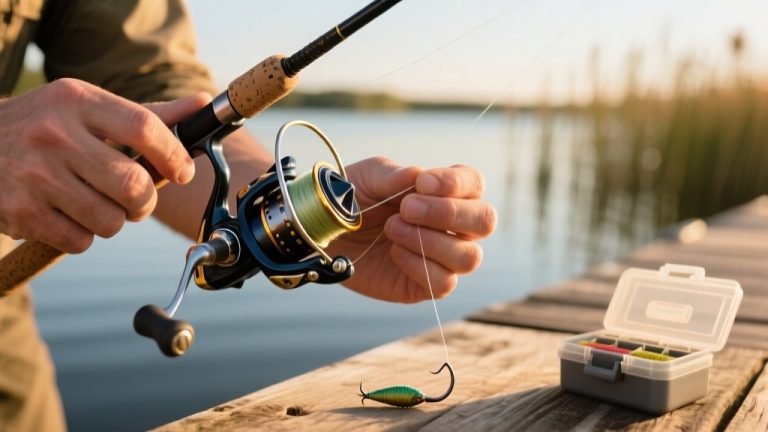
For catching bass in brackish water, you’ll want medium-action spinning or baitcasting rods paired with 8-15 lb braided or fluorocarbon line for sensitivity and abrasion resistance.
Use lures like soft plastics, jigs, or topwater plugs mimicking baitfish or crustaceans common in estuaries.
Include a fluorocarbon leader to reduce visibility. A variety of live or cut bait, such as shrimp or small baitfish, also works well in these mixed-salinity environments.
Which Bass Species Can Survive in Saltwater?
When fishing for bass near saltwater, remember not all bass can swim with the tide. Striped bass thrive in salty or brackish environments, while largemouth bass are limited to freshwater due to their low salt tolerance.
Understanding these salinity needs helps you target the right species and improve your catch. By knowing which bass species can handle saltwater, you’ll avoid fishing in the wrong pond and increase your chances of success.