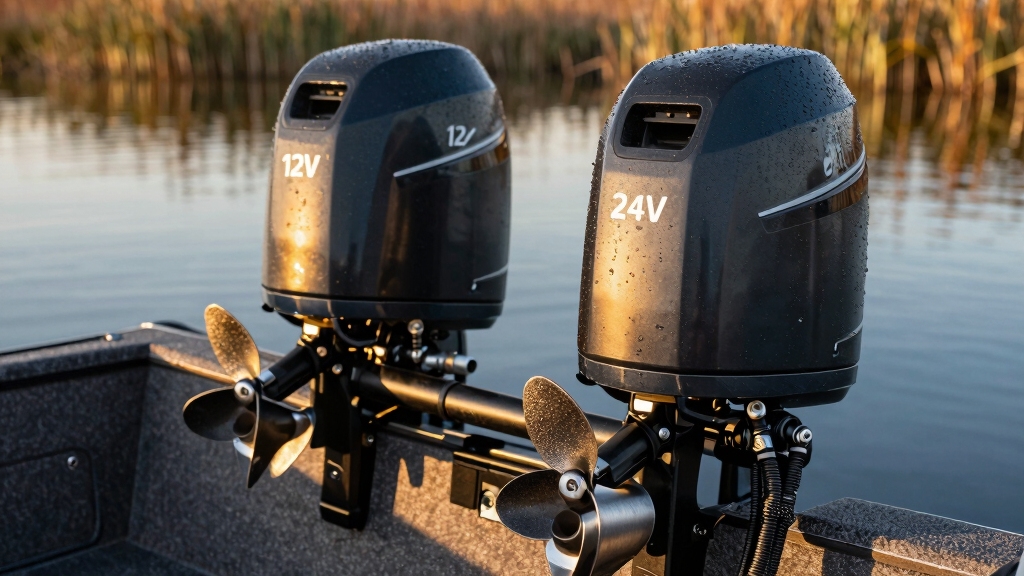
12 Volt Vs 24 Volt Trolling Motor: Everything You Need to Know
If you want simpler installation and moderate thrust up to 55 pounds, a 12V trolling motor with a single battery suits smaller boats in calm waters.
But if you need stronger power, up to 80 pounds of thrust, better efficiency, and longer runtime, a 24V system wired with two batteries in series is ideal.
It cuts current draw, reduces heat, and improves performance. Choosing the right voltage depends on boat size and conditions.
Explore the details to optimize your setup.
Key Takeaways
- 24V motors deliver up to 80 pounds of thrust, outperforming 12V motors that provide about 55 pounds.
- 24V systems halve current draw, improving efficiency and reducing heat by approximately 25% compared to 12V setups.
- 12V motors use a single battery for easier installation but offer limited runtime and thrust.
- Two 12V batteries wired in series power 24V motors, extending runtime but requiring more complex wiring.
- 12V suits small boats in calm waters; 24V is better for larger boats or conditions with moderate currents.
12V vs 24V Trolling Motors: Key Differences
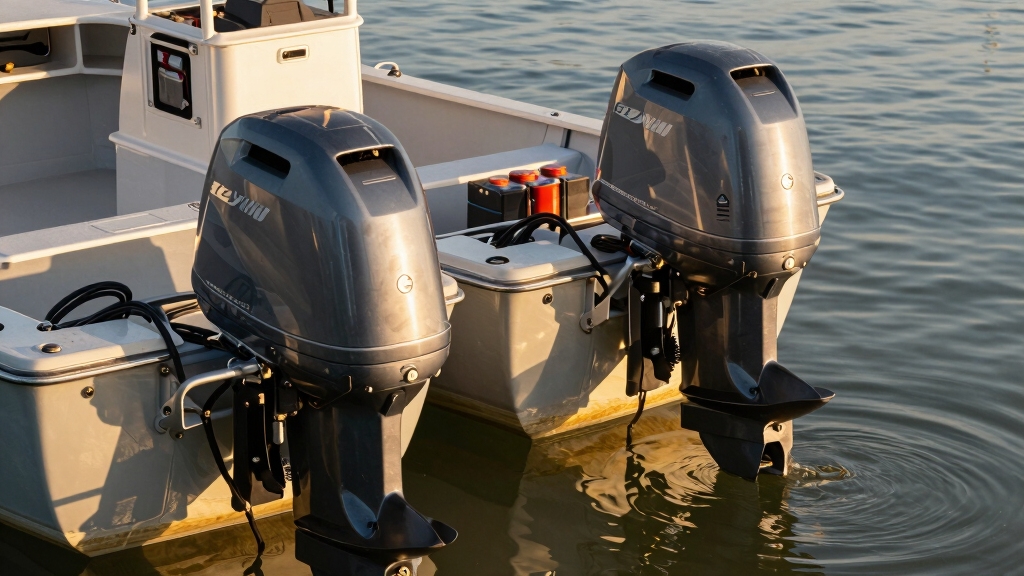
When comparing 12V and 24V trolling motors, you’ll notice key differences in power delivery and efficiency that directly impact performance and battery management.
Key differences in power delivery and efficiency shape trolling motor performance and battery management.
A 24V system typically delivers up to 80 pounds of thrust, markedly exceeding the 55 pounds offered by most 12V motors. This higher voltage reduces current draw by half for equivalent power, minimizing heat loss and enhancing motor efficiency by approximately 25%.
You’ll also find that 24V setups rely on two 12V batteries wired in series, effectively doubling voltage while maintaining capacity. This improves runtime and battery longevity.
In contrast, 12V motors run off a single battery, simplifying installation but limiting thrust and runtime.
Opting for 24V is advisable for larger boats or challenging conditions where sustained power and efficiency are critical.
Additionally, running motors at lower speeds or using multiple batteries in parallel can help extend battery runtime regardless of voltage system.
How Voltage Impacts Trolling Motor Power and Control?
Although voltage alone doesn’t determine a trolling motor’s overall performance, it markedly influences both power output and control responsiveness.
When you choose a 24-volt system, you effectively increase thrust capacity up to 80 pounds compared to 55 pounds with 12 volts. This enables better handling of larger boats and challenging conditions.
This higher voltage reduces current draw, improving efficiency by about 25%. This translates into less heat generation and more consistent motor operation.
You’ll notice enhanced control precision in moderate currents as the motor can maintain full throttle more effectively. Conversely, 12-volt setups deliver sufficient power for smaller craft but lack the torque and responsiveness you get with 24 volts.
Ultimately, voltage impacts how smoothly and powerfully you can maneuver, especially in demanding environments.
Additionally, brushless motor designs, such as those found in the Garmin Force, improve efficiency and extend battery life compared to traditional motors, enhancing overall system performance and durability brushless motor technology.
Battery Setups: Effects on Runtime and Maintenance
Optimizing battery setups directly impacts both the runtime and maintenance demands of your trolling motor system.
With 12V, you typically use a single battery, which simplifies installation and upkeep but limits runtime. A 24V setup uses two 12V batteries in series, doubling voltage and extending runtime markedly.
However, it requires more complex wiring and maintenance to guarantee battery balance and connection integrity. Choosing between single and dual battery setups affects how long you fish and how often you maintain your system. Proper attention to material durability and corrosion resistance in connections can help reduce maintenance issues over time.
| Setup Type | Runtime (hrs) | Maintenance Complexity |
|---|---|---|
| 12V Single | 4-5 (55 lb motor) | Low |
| 24V Dual Series | 6-8 (90 lb motor) | Moderate |
| 24V Single Battery | Varies (higher capacity) | Low |
| 12V Dual Parallel | Extended (rare use) | Moderate |
| 24V Dual Parallel | High capacity | High |
Efficiency Advantages of 24V Trolling Motor Systems
Battery configurations influence not only runtime and maintenance but also the overall efficiency of your trolling motor system.
When you opt for a 24V setup, you effectively halve the current draw compared to a 12V system delivering the same power. This markedly reduces heat loss in wires and motor components.
This lower amperage enhances motor efficiency by about 25%. It allows your motor to run cooler, perform better, and extend battery life.
Additionally, the dual-battery series configuration in a 24V system doubles voltage while maintaining capacity. This enables the motor to operate at higher thrust levels without compromising efficiency.
You’ll notice improved control and longer runtime, especially under demanding conditions like moderate currents or windy weather.
This makes 24V systems a technically superior choice for serious anglers.
However, just as proper pairing of equipment is crucial in fishing gear setups, ensuring your trolling motor system components are compatible is essential for optimal performance and durability, similar to the importance of proper reel-rod pairing.
How to Choose the Right Trolling Motor for Your Boat?
Selecting the right trolling motor hinges on understanding your boat’s size, typical water conditions, and intended usage.
Choosing the ideal trolling motor depends on your boat size, water conditions, and how you plan to use it.
For boats under 16 feet operating in calm inland waters, a 12V system with up to 55 pounds of thrust usually suffices. It offers simplicity and ease of installation.
If you have a larger boat or expect moderate currents and windy conditions, choosing a 24V motor is prudent. It delivers up to 80 pounds of thrust, runs more efficiently, and extends runtime.
Also consider your fishing duration. Longer trips benefit from 24V’s dual-battery setups, which provide greater capacity.
Installation complexity and budget are factors too. 12V systems are easier and more compact, while 24V systems require series wiring expertise but offer superior power and control.
Match the motor’s voltage and thrust to your specific boating profile for peak performance.
Additionally, pairing your trolling motor with high-quality rod holders featuring 360-degree rotation can significantly enhance your fishing experience by providing stable and adjustable support during trolling.
Frequently Asked Questions
Can I Use a 24V Motor With Only One 12V Battery?
You can’t properly run a 24V trolling motor with just one 12V battery because the motor requires 24 volts to operate efficiently.
Using a single 12V battery underpowers the motor, leading to poor performance and potential damage.
To safely and effectively power a 24V motor, you need two 12V batteries connected in series to provide the correct voltage.
This guarantees peak thrust, runtime, and motor longevity.
How Does Temperature Affect 12V and 24V Trolling Motor Performance?
Temperature affects your trolling motor’s efficiency, power output, and battery performance.
Cold temperatures reduce battery capacity and increase internal resistance, lowering runtime for both 12V and 24V systems.
Higher temps boost chemical reactions but risk overheating, causing thermal stress and efficiency loss.
Since 24V motors draw less current, they handle heat buildup better, maintaining performance longer.
You should monitor temperature closely to prevent damage and optimize motor longevity in any voltage setup.
Are 24V Trolling Motors Noisier Than 12V Models?
No, 24V trolling motors aren’t inherently noisier than 12V models. Both voltage systems use similar motor designs, so noise levels mostly depend on build quality and motor type.
In fact, 24V motors often run more efficiently at lower current, which can reduce heat and mechanical strain, potentially minimizing noise.
If noise is a concern, focus on brand reputation, motor insulation, and proper installation rather than just voltage.
What Safety Precautions Are Needed When Installing 24V Systems?
You should know 24V systems draw half the amperage of 12V setups, reducing heat loss but requiring careful wiring.
Always disconnect batteries before installation to avoid shorts. Use properly rated fuses and marine-grade wiring to handle higher voltage safely.
Make certain correct series wiring of two 12V batteries to maintain balanced voltage. Double-check polarity to prevent damage.
Secure connections to avoid corrosion or loosening during operation.
Can I Upgrade a 12V System to 24V Without Replacing the Motor?
You generally can’t upgrade a 12V system to 24V without replacing the motor.
The motor’s windings and electronics are designed for specific voltage and current ratings.
Applying 24V to a 12V motor risks overheating or damaging it.
For a proper 24V upgrade, you need a motor built for 24V operation, along with compatible batteries and wiring.
Always verify motor specifications before attempting voltage upgrades to guarantee safe, reliable performance.
Choosing the Right Voltage for Better Performance on the Water
Choosing between a 12V and 24V trolling motor is like picking the right tool for your job. Each has its strengths.
A 12V motor offers simplicity and ease, while 24V systems deliver greater power and efficiency. This is especially true for larger boats or extended use.
By understanding voltage impacts, battery setups, and performance needs, you’ll make a precise choice. This maximizes control, runtime, and maintenance ease on the water.