Center Console vs Bay Boat: Everything You Need to Know
If you fish in shallow bays or flats, a bay boat’s shallow draft and flat hull let you access skinny water with ease.
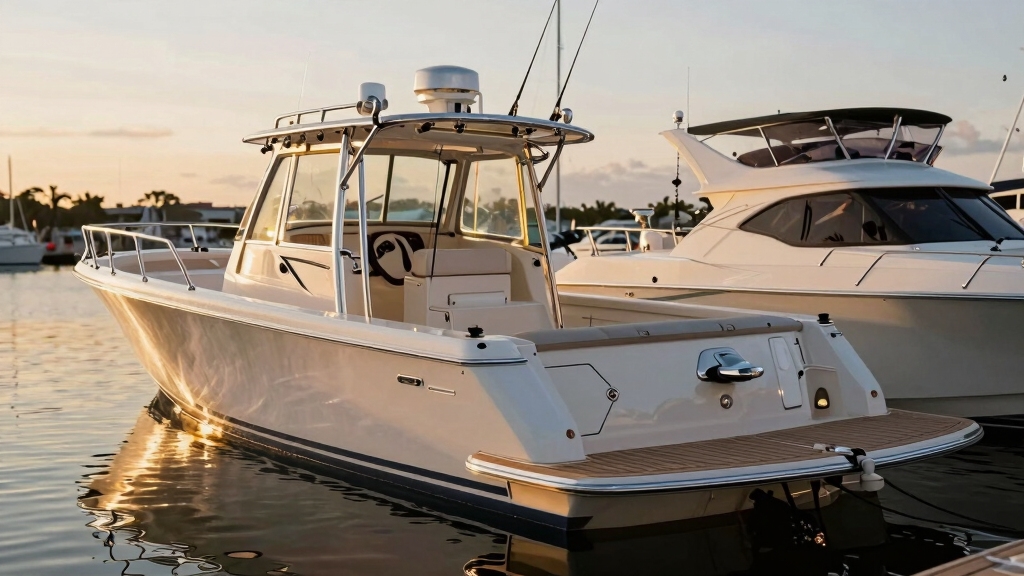
Center consoles excel offshore with deep-V hulls offering stability in rough seas. Bay boats prioritize elevated casting platforms and maneuverability. Center consoles provide open 360-degree decks and larger livewells for multi-angler trips.
Efficiency, cost, and maintenance differ too. Understanding these key aspects helps you pick the boat best suited for your fishing style and location.
Key Takeaways
- Bay boats are smaller (18–26 ft), designed for shallow bays with flat hulls and shallow drafts for easy maneuvering in skinny water.
- Center consoles are larger (22–40+ ft) with deep-V hulls, built for offshore stability, rough water handling, and extended trips.
- Bay boats feature elevated bow and stern casting platforms ideal for sight fishing in shallow water.
- Center consoles provide 360-degree open decks and integrated rod storage, supporting multi-angler offshore fishing.
- Bay boats generally offer better fuel economy in shallow water; center consoles prioritize performance and capacity for offshore conditions.
Quick Comparison of Bay Boats and Center Consoles
| Feature | Bay Boat | Center Console |
|---|---|---|
| Length | 18–26 ft | 22–40+ ft |
| Draft | Shallow (8–14 in) | Deep (20–25° deadrise) |
| Hull Type | Flat/Moderate V | Deep-V hull for offshore stability |
| Deck Layout | Elevated bow & stern casting platforms | 360-degree open decks with integrated rod storage |
| Fishing Gear Capacity | Smaller livewells & fish boxes, lockable rod lockers | Large livewells & fish boxes, multiple rod holders |
| Water Access | Shallow bays, flats, estuaries | Offshore and rough water conditions |
| Fuel Efficiency | Efficient in shallow water | Higher fuel consumption for performance |
| Cost & Maintenance | Lower upfront & simpler maintenance | Higher upfront cost & more maintenance |
| Special Features | Shallow-water anchors, raised casting decks | T-tops, heavy-duty anchors, outriggers for trolling |
| Multi-Angler Use | Limited | Ideal for multiple anglers |
Bay Boats vs Center Consoles: Key Differences Overview
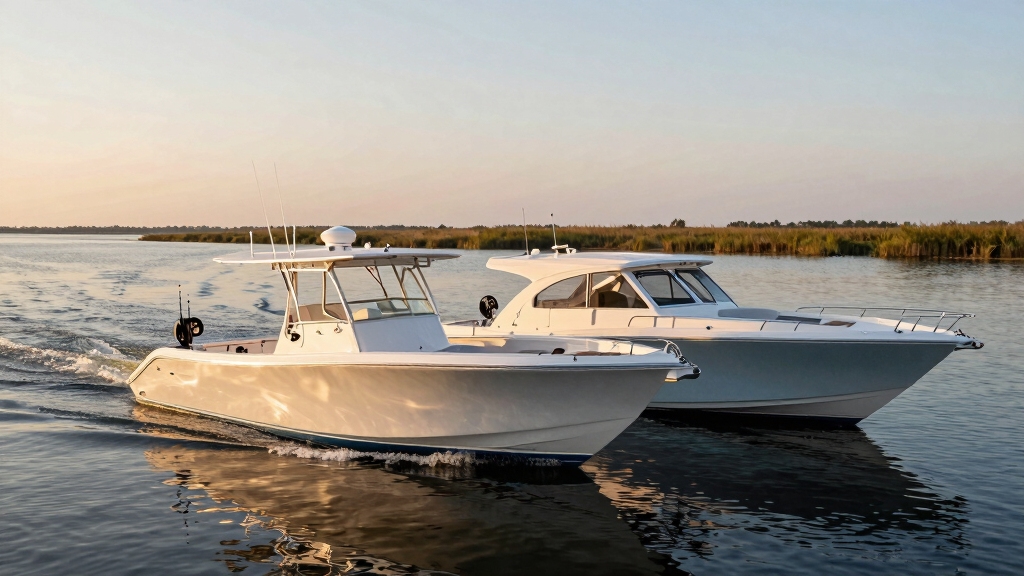
While both bay boats and center consoles serve anglers and boaters, they differ markedly in size, design, and intended use.
Bay boats typically range from 19 to 26 feet, featuring shallower drafts ideal for skinny waters like bays, flats, and tidal creeks. Their smaller size eases trailering and storage, offering limited deck space and basic fishing setups such as raised casting decks and trolling motors. They are especially favored for their shallow-water accessibility which allows anglers to navigate estuaries and flats with ease. Their hull designs prioritize initial stability to maintain steadiness in calm, shallow waters.
Conversely, center consoles span 22 to over 40 feet with deeper hulls designed for offshore navigation. They provide expansive 360-degree decks, larger baitwells, and higher horsepower capacity, enhancing stability in rough seas. Center consoles demand larger trailers and tow vehicles.
Cost-wise, bay boats generally involve lower upfront and maintenance expenses, while center consoles offer greater versatility for offshore fishing, cruising, and watersports.
How Hull Design Affects Boat Performance?
Understanding how hull design influences boat performance helps clarify why bay boats and center consoles behave differently on the water.
Bay boats feature shallower, flatter hulls with a deadrise angle of 10-15 degrees, enhancing stability and efficiency in calm, shallow waters.
Bay boats’ shallow hulls and 10-15 degree deadrise boost stability and efficiency in calm, shallow waters.
Their hulls integrate pads or tunnels to minimize draft, supporting maneuverability and fuel economy. Bay boats also commonly have features like a stepped hull or tunnel to further reduce draft and enable running in very shallow water, which is ideal for inshore fishing in bays and estuaries shallow-water access.
In contrast, center consoles employ deeper V-shaped hulls with deadrise angles between 20-25 degrees, sometimes up to 24 degrees offshore.
This design improves wave-cutting ability, reduces pounding, and offers superior stability in rough seas.
Consequently, hull shape and deadrise angle directly dictate each boat’s handling, ride quality, and suitability for specific water conditions.
Draft And Size: Navigating Shallow vs Deep Waters
Because draft and size determine where you can safely navigate, choosing between a bay boat and a center console depends largely on your typical water conditions.
Bay boats feature a shallow draft of 8–14 inches and a low deadrise angle of 10–15 degrees, allowing you to access skinny water, tidal creeks, and back bays with ease. Their compact 18–26 foot length enhances maneuverability and trailering convenience. Many bay boats also benefit from shallow-water capabilities that complement their design for exploring coastal flats.
Conversely, center consoles have a deeper draft with a deadrise angle between 20 and 25 degrees, designed for offshore stability rather than shallow water access. They typically include rod holders and T-tops that enhance fishing versatility and comfort.
Ranging from 22 to over 40 feet, they accommodate larger crews but require specialized storage and launching.
Your choice hinges on whether you prioritize shallow-water exploration or open-water performance.
Fuel Efficiency And Power: Which Boat Fits Your Needs?
If you want to balance power with fuel efficiency, choosing between a center console and a bay boat depends on your typical cruising speeds and engine configurations.
For 18-foot center consoles with 115 hp outboards, expect about 5.0 mpg at 30 mph, improving to 7.7 mpg at trolling speeds. However, remember that fuel economy can vary significantly even among boats of the same size due to differences in hull design and operating conditions (fuel economy variation). Additionally, heavier boats require more thrust, increasing current draw and reducing fuel efficiency.
Bay boats, often heavier with moderate vee hulls, deliver 5-7 mpg at planing speeds around 15 mph, with diesel variants offering 3-3.5 nmpg at 25-30 knots.
Larger boats, 25 to 30 feet, show minimal efficiency differences. Battery weight and type can also affect overall boat performance and fuel consumption, especially in electrically assisted propulsion setups.
A 25-foot center console with 300 hp averages 3.2 mpg at 30 mph, while twins drop to 1.7 mpg.
Diesel engines in bay boats double efficiency compared to gas outboards.
Your fuel economy hinges on boat size, weight, engine type, and cruising profile.
Fishing Features: Comparing Bay Boats And Center Consoles
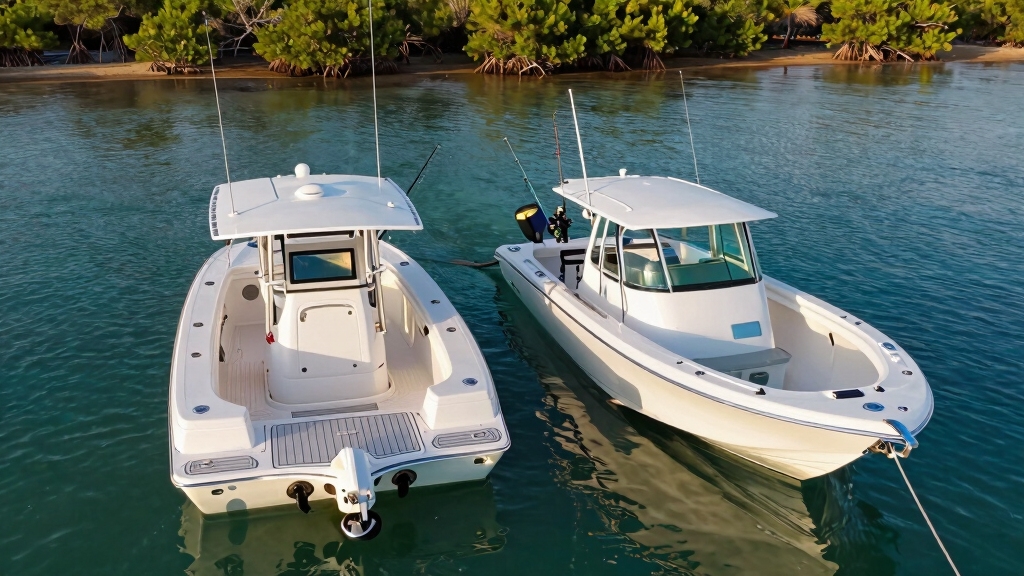
When you compare fishing features, you’ll see that center consoles really shine with their open, 360-degree decks. This design allows for multiple anglers to fish comfortably and provides plenty of room for gear storage. It’s perfect for those days when you want to bring along all your equipment. Their versatility makes them suitable for various fishing methods including trolling with medium-heavy power rods.
On the flip side, bay boats are all about raised casting platforms and simplified layouts. They’re optimized for shallow, inshore fishing, making them a great choice for navigating those tighter spots. Their shallower draft enables access to skinny water and backcountry fishing areas that center consoles might not reach as easily.
But both types of boats come equipped with specialized gear like livewells and rod holders, tailored specifically for their typical fishing environments. So, whether you prefer the spaciousness of a center console or the efficiency of a bay boat, there’s something for every angler out there!
Deck Layout Differences
Although both center consoles and bay boats cater to anglers, their deck layouts reflect distinct priorities in fishing functionality. You’ll notice these key differences:
- Access and Mobility: Center consoles provide 360-degree access around a central helm, enabling unobstructed movement bow to stern. This design also facilitates easy installation of rod holders around the console for versatile fishing setups. Bay boats have raised bow and stern casting decks, limiting full walkaround capability.
- Casting Platforms: Bay boats feature dedicated elevated casting decks for better sight fishing in shallow waters. Center consoles offer expansive flat decks for casting from multiple angles.
- Bow Configuration: Center consoles have open bows allowing lounging or fishing without barriers. Bay boats prioritize raised bow decks for stability in skinny water. Additionally, center consoles are designed with a deep-V hull that enhances comfort and ride in choppy waters.
- Stern Layout: Center consoles maintain flat stern decks with integrated rod storage and transom doors. Bay boats emphasize elevated stern casting platforms over flat areas. Both often incorporate corrosion-resistant fixtures and mounts to support fishing gear in marine environments.
These design choices reflect each boat’s targeted fishing environment and style.
Fishing Gear Capacity
Fishing gear capacity plays a crucial role in choosing between a center console and a bay boat, as each design caters to different angling needs.
Bay boats offer lockable rod lockers for around 10 rods, typically integrated into raised casting decks. They also include 25-gallon gunwale livewells suited for inshore fishing. Their shallow draft of 8–14 inches allows anglers to access skinny water areas where fishing opportunities abound. Many bay boats are ideal for specialized gear setups, including planer board configurations that enhance trolling presentations.
Their insulated bow fish boxes are smaller due to compact size. In contrast, center consoles provide integrated rod storage throughout the deck with multiple rod holders for 360-degree access.
This supports more rods, especially on models 35 feet and larger. Center consoles feature large livewells and oversized baitwells, with multiple livewells in 22-40 foot models.
They also have spacious integrated fish boxes designed for offshore catches. You’ll find center consoles better equipped for prolonged trips with ample storage for gear and electronics.
Specialized Fishing Features
Explore how specialized fishing features distinguish bay boats from center consoles, tailoring each to specific angling environments.
Bay boats excel in inshore conditions with raised casting decks for better sight casting, compact livewells optimized for shallow waters, shallow-water anchors for precise positioning, and simple rod holders ideal for tight maneuvers.
In contrast, center consoles suit offshore fishing with flat, open decks offering 360-degree access, larger livewells accommodating diverse bait, heavy-duty anchors for stability in rough seas, and multiple rod holders plus outriggers for trolling.
Consider these key differences:
- Bay boats’ raised decks enhance targeting species like redfish.
- Center consoles support multiple anglers fishing simultaneously.
- Bay boats prioritize minimal draft anchoring.
- Center consoles integrate flush-mount rod storage and tackle stations.
Choosing the right boat type also means considering stability and traction, similar to selecting proper wading boots, to ensure safety and performance in varying water conditions.
Cost And Maintenance: What To Expect For Each Boat Type?
When you’re looking at cost and maintenance, center console boats usually come with a higher price tag upfront. This is mainly because they’re built for offshore adventures and have a more complex hull design. So, if you decide to go for one, just keep in mind that you might spend about 10% of the purchase price each year on upkeep.
Maintenance costs can vary depending on the cruising area, with saltwater use typically requiring more preventative care to avoid damage. Saltwater environments demand corrosion-resistant materials and regular maintenance to prevent damage from salt and tides.
Plus, center consoles often need more engine servicing and can rack up storage costs, especially if you’re planning to use wet slips.
On the other hand, bay boats are a bit easier on the wallet. They generally have a lower entry price and their maintenance costs are also less daunting. This is largely due to their simpler construction and the fact that they can be stored in the water more easily.
Choosing The Right Boat For Your Fishing Location
Selecting the right boat hinges largely on the fishing environment you plan to navigate. If you primarily fish in shallow inshore waters like flats, bays, or estuaries, a bay boat with its shallow draft (8–14 inches) and raised casting decks offers ideal access and sight casting advantages.
The shallower draft of bay boats enables access to fishing spots and sandbars unreachable by deeper-draft boats. Proper equipment matching, similar to choosing the right reel for a rod, ensures optimal performance in these environments through appropriate design features like guide layout and structural considerations.
Conversely, for offshore or rough water conditions, center consoles with deep-V hulls (24-degree deadrise) provide superior stability and seaworthiness. Like the importance of using compatible gear in fishing setups, the design of center consoles supports optimal handling in challenging conditions.
Consider these factors:
- Shallow waters require bay boats for maneuverability and access.
- Offshore trips demand center consoles with higher horsepower and fuel capacity.
- Bay boats simplify inshore fishing with trolling motors and shallow-water anchors.
- Center consoles excel in multi-rod fishing and rough seas with advanced layout features.
Match your boat choice to your typical fishing location for safety and performance.
When A Hybrid Boat Makes Sense?
When you weigh the benefits of hybrid boats, fuel economy and environmental impact often come to the forefront.
You can expect 15–25% fuel savings compared to diesel vessels and up to 25% lower emissions, which helps meet strict regulations.
Hybrid boats deliver quieter operation, reducing noise and vibration for better comfort, especially during night navigation.
Additionally, some models incorporate energy recovery during deceleration to optimize efficiency and extend battery life.
However, you should consider the 15–30% higher upfront cost and limited electric range of 2–8 hours, which may not suit long-distance cruising.
The added technological complexity requires specialized maintenance, though electric motors reduce mechanical breakdowns.
A hybrid boat makes sense if you prioritize sustainability, operate mainly in coastal or bay areas, and value quieter, cleaner propulsion while accepting higher initial investment and some operational constraints.
Frequently Asked Questions
Can Bay Boats Be Easily Customized With Aftermarket Accessories?
Yes, you can easily customize bay boats with a wide range of aftermarket accessories.
You’ll find options like stainless steel fender locks, T-Top rod holders, custom dash panels, and semi-custom boat covers designed for bay boat hulls.
Installation is straightforward thanks to OEM-quality parts tailored for specific models.
Plus, suppliers offer fully custom projects, CNC-cut components, and extensive support, ensuring your upgrades fit perfectly and enhance your boating experience.
What Are the Typical Insurance Costs for Center Consoles Versus Bay Boats?
Insurance costs for center consoles typically run higher than bay boats, often reflecting their offshore use and multiple outboards.
You can expect premiums around $100–$300 monthly for center consoles, while bay boats usually fall toward the lower $25–$75 range per month.
Coastal locations and boat value further influence rates. Think of it as a tide: the more horsepower and offshore risks, the higher your premiums will surge.
Are Center Consoles Better Suited for Family Outings Beyond Fishing?
Yes, center consoles can be great for family outings beyond fishing.
You’ll appreciate features like T-tops for sun and rain protection, and forward seating with removable cushions that create lounge areas.
Swim platforms with ladders provide easy water access.
Their open layout offers ample space for movement and versatile activities like kayaking or cruising.
Plus, storage options convert to extra seating, making your family time comfortable and functional.
How Do Bay Boats Perform in Windy Conditions Compared to Center Consoles?
Imagine riding a bike with thin tires on a windy day. You’ll wobble a lot.
Bay boats, with their flat, shallow hulls, perform similarly in windy conditions, experiencing more pounding and less stability. They drift more and struggle in rough seas.
In contrast, center consoles have deep-V hulls that slice through waves. This design offers you a smoother, more controlled ride when winds pick up offshore.
Do Either Boat Types Have Advantages in Resale Value Over Time?
You’ll find center consoles generally hold better resale value over time due to strong market demand and growth projections.
Their popularity in recreational fishing and frequent new model releases support liquidity.
Bay boats lack specific resale data, making their value less predictable.
However, dealer caution due to potential quick depreciation affects both types.
Monitoring real-time pricing tools like Boat Trader helps you gauge current resale trends accurately.
Choose the Right Boat for Your Fishing Environment
Choosing between a bay boat and a center console ultimately comes down to your specific fishing environment and preferences.
While each offers distinct advantages in hull design, draft, and features, neither is universally superior—just differently suited.
By understanding these subtle nuances, you can avoid the common pitfalls of mismatched expectations and select a vessel that gracefully balances performance, efficiency, and maintenance.
This thoughtful approach guarantees your time on the water is both productive and enjoyable.