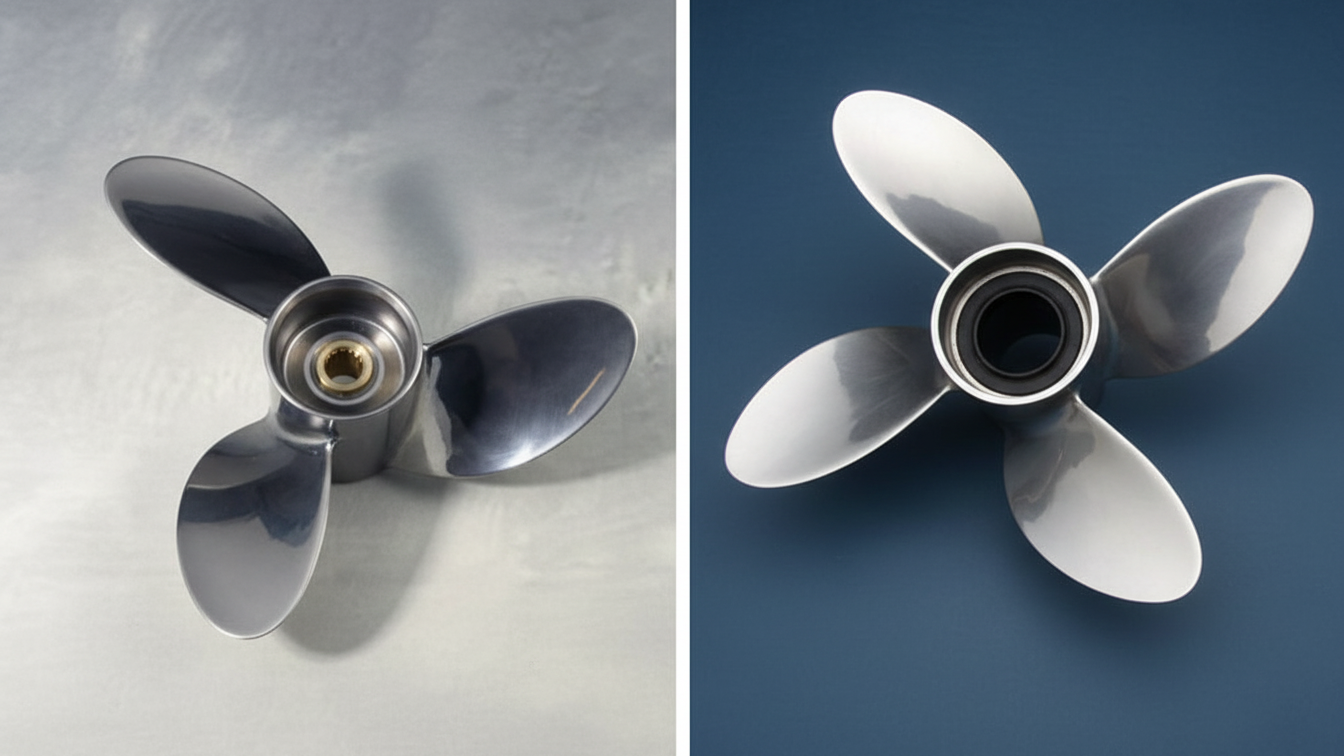
3 Blade vs 4 Blade Propeller: Which Delivers Better Results
If you want higher top speed and better fuel efficiency, a 3-blade propeller is your best bet.
It reduces drag with fewer blades, allowing your engine to reach higher RPMs and cruise more economically.
On the other hand, a 4-blade prop provides stronger thrust, superior acceleration, and improved control under heavy loads or rough water.
This is thanks to its increased blade area and grip. Understanding these differences helps you select the ideal prop for your specific boating needs.

- 3-Blade Propeller for Reliable Performance — Engineered for Superior Trolling Efficiency. Designed…
- Universal Compatibility with MotorGuide Models — Direct Fit for 3.5″ Diameter MotorGuide Trolling…
- Durable Corrosion-Resistant Construction — Built to Endure Harsh Marine Conditions. Crafted from…

- 14″ diameter, 21″ pitch, right-hand rotation
- For use with 90-115hp Command Thrust and 150-300hp Mercury/MerCruiser engines
- Aluminum with black finish

Key Takeaways
- 3-blade propellers offer higher top speed and better fuel efficiency due to lower drag and smaller blade area.
- 4-blade propellers provide superior acceleration, thrust, and planing ability, especially under heavy loads or rough water.
- Four blades increase water grip and reduce ventilation, improving control and stability during sharp turns or rough conditions.
- 3-blade props are ideal for speed-focused boats, while 4-blades suit towing, heavy ballast, and rough sea performance.
- Proper selection balances blade count with diameter and pitch to match engine power and desired performance characteristics.
Quick Comparison of 3-Blade and 4-Blade Propellers
| Performance Factor | 3-Blade Propeller | 4-Blade Propeller |
|---|---|---|
| Top Speed | Delivers higher maximum speed due to reduced drag | Slightly lower top speed from added blade resistance |
| Acceleration | Moderate hole-shot with smooth power delivery | Stronger acceleration from increased blade area |
| Fuel Efficiency | More fuel-efficient at cruise and high speeds | Higher fuel use caused by added drag |
| Thrust Output | Balanced thrust suited for lighter loads | Greater low-end thrust and power transfer |
| Handling & Control | Responsive steering in calm conditions | Improved control in rough water and sharp turns |
| Vibration & Smoothness | Slightly more vibration at low speeds | Smoother operation with reduced pressure pulses |
| Load Carrying Ability | Performs best with lighter boats and setups | Excels under heavy loads and towing demands |
| Planing Performance | Requires more speed to stay on plane | Maintains plane at lower RPMs |
How 3-Blade Vs 4-Blade Propellers Affect Performance?
When evaluating how 3-blade and 4-blade propellers affect performance, you’ll find that blade count directly influences efficiency, power absorption, thrust generation, and operational smoothness.
Increasing blades from three to four raises power absorption due to intensified aerodynamic interactions. This results in a reduction of overall propeller efficiency despite modern airfoil designs mitigating some losses.
More blades enable higher thrust within smaller diameters, which is essential for compact installations requiring efficient power conversion at elevated engine outputs.
You’ll also notice that thrust delivery becomes smoother with additional blades. This helps distribute pressure pulses more evenly and reduces vibration.
This vibration reduction not only enhances operational smoothness but also lessens structural stress. However, adding more blades can increase sources of blade tip vortices, potentially leading to higher energy losses at low advance ratios blade tip vortices.
Consequently, selecting between 3-blade and 4-blade designs involves balancing slightly diminished efficiency against improved thrust capacity and smoother operation in constrained spatial environments.
Why 3-Blade Propellers Deliver Higher Top Speeds?
Choosing between 3-blade and 4-blade propellers often comes down to the specific performance goals you want to achieve.
Selecting 3-blade or 4-blade propellers depends largely on your desired boat performance outcomes.
When top speed is your priority, 3-blade props outperform 4-blade variants due to reduced drag from fewer blades and smaller total blade area.
This decreased wetted surface lowers hydrodynamic resistance, allowing higher RPM and improved velocity at wide-open throttle.
For example, a 3-blade 17-pitch prop can reach 49 MPH at 5800 RPM, surpassing a 4-blade’s 47 MPH.
Real-world tests confirm consistent 1-2 MPH top-speed gains after swapping to 3-blade configurations.
Additionally, reduced drag enhances fuel efficiency during sustained high-speed runs.
Moreover, the reduced blade area in 3-blade propellers results in less force exerted on the water, which contributes to their ability to achieve higher speeds.
How 4-Blade Propellers Improve Acceleration and Planing?
Experience immediate power delivery with 4-blade propellers, which generate greater thrust through increased blade surface area compared to 3-blade designs. This expanded surface area enhances low-speed thrust, enabling faster acceleration and quicker planing. You’ll notice improved hole-shot performance, ideal for towing and maintaining planing in rough conditions while also reducing propeller ventilation.
The additional blade grip reduces ventilation during dynamic maneuvers, sustaining efficient thrust. Four-blade propellers also provide more stern lift, which contributes to better stability and balance in challenging water conditions.
| Performance Aspect | 4-Blade Advantage |
|---|---|
| Acceleration | Faster hole-shot and planing times |
| Low-Speed Planing | Maintains plane at reduced speeds |
| Maneuverability | Resists ventilation during sharp turns |
Comparing Drag and Fuel Efficiency of 3-Blade Vs 4-Blade Props
While 4-blade propellers offer superior acceleration and control in challenging conditions, their increased blade surface area also affects drag and fuel consumption.
4-blade propellers excel in acceleration and control but increase drag and fuel consumption due to larger blade area.
With more blade area pushing water, 4-blades generate higher hydrodynamic drag, resulting in increased fuel use during cruising. This higher drag is similar to how boat weight impact can increase motor load and reduce efficiency.
In contrast, 3-blade props have less wetted surface and fewer blades in contact with water, reducing drag and enhancing fuel efficiency at sustained speeds.
This lower drag enables 3-blade props to achieve higher RPMs and top speeds with better fuel economy, especially in light, speed-focused boats.
Although 4-blades maintain plane at lower RPMs, this doesn’t fully offset their drag penalty, making them less efficient at cruise.
It is important to note that the number of blades also influences the amount of vibration experienced during operation, with 4-blade props typically providing a smoother ride.
Consequently, if your priority is minimizing drag and maximizing fuel efficiency, 3-blade propellers generally provide a marginal advantage under calm, low-load conditions.
Which Propeller Handles More Power and Heavy Loads Better
When it comes to handling power and heavy loads, 4-blade propellers really shine. They do a fantastic job of distributing power evenly, which is a big plus when you’re dealing with heavier loads.
You see, the additional blade surface gives them better grip, helping to reduce slip. That’s super important when you’re pushing the limits. The extra blade area also provides better hole shot and acceleration, making these props ideal for towing or rough water conditions.
But here’s the catch: while 4-blade propellers are great for load handling, they do require more from your engine. So, if you’re considering making the switch, it’s crucial to ensure that the prop specs align with your engine’s power output. That way, you can maximize performance without overworking your engine.
Power Delivery Comparison
Because a 4-blade propeller generates more horsepower at the same RPM than a 3-blade, it handles heavier loads and increased engine power more efficiently.
You’ll notice that the additional blade area on a 4-blade pushes more water per revolution, converting engine output into thrust with greater effectiveness.
This results in smoother power absorption and reduced vibrations during high-load operation.
Consider these key aspects of power delivery:
- Enhanced horsepower transfer due to four blades exerting force simultaneously
- Smoother pressure pulses reduce mechanical stress and improve durability
- Increased drag requires careful RPM management but supports sustained power output
- Many operators report improved handling and reduced vibration with four-blade props, enhancing overall boat control under load
- Proper matching of propeller design to engine power is crucial to avoid performance limitations and equipment stress.
Ultimately, if your priority is precise power delivery under demanding conditions, a 4-blade propeller offers superior performance compared to a 3-blade design.
Load Handling Capacity
Building on the power delivery advantages of a 4-blade propeller, its load handling capacity further distinguishes it from a 3-blade design. The increased blade count boosts the diameter area ratio to 60-65%, generating greater thrust at lower RPMs, which is critical for heavy loads. This enhanced thrust is achieved because the blades form a helicoidal spiral producing linear thrust, effectively converting engine power into propulsion.
You’ll notice improved acceleration, planing, and control, especially in rough seas or under heavy ballast. The larger total blade area guarantees better water grip, reducing ventilation and maintaining efficiency. This is similar to how brushless motors provide quieter operation and longer run times by increasing efficiency in marine applications.
Additionally, 4-blade props typically use stainless steel, offering superior strength and durability under sustained torque and pressure. This makes them ideal for towing, watersports, and boats carrying significant gear or passengers.
In contrast, 3-blade propellers often sacrifice load capacity for speed, making 4-blades the practical choice for heavy-duty marine applications.
Picking the Right Propeller for Your Boat’s Needs
When selecting a propeller for your boat, consider the balance between blade count, diameter, pitch, and material to match your specific performance needs. It’s important to ensure a secure connection between lines when assembling or repairing your rigging.
Three-blade propellers offer superior top-end speed and balanced acceleration.
Three-blade propellers deliver excellent top speed combined with smooth and balanced acceleration performance.
Four-blade designs enhance lift and reduce cavitation, ideal for heavier or stern-heavy boats.
Diameter influences thrust versus drag.
Larger diameters suit heavy loads, while smaller diameters maximize speed.
Pitch affects engine RPM and speed; ensure your prop allows the engine to reach the recommended WOT RPM range to avoid damage.
Material choice impacts durability and performance.
Stainless steel offers superior strength and efficiency for high-speed boats.
- Match blade count to your boat’s power and planing characteristics.
- Balance diameter and pitch to optimize thrust and engine load.
- Choose material based on budget, durability needs, and operating conditions.
- Remember that pitch and rpm are inversely related, so changing pitch affects engine rpm accordingly.
Frequently Asked Questions
What Materials Are Commonly Used for 3-Blade and 4-Blade Propellers?
You’ll find both 3-blade and 4-blade propellers commonly made from advanced composites like carbon fiber infused with epoxy resin, offering a high strength-to-weight ratio and precise blade geometry.
Some use aerospace-grade aluminum alloys for hubs and blades, especially where durability is essential.
Wood laminates remain in use for specific applications, but modern designs lean heavily on thermoset epoxy composites and aluminum for peak performance, weight reduction, and structural integrity.
How Do Propeller Pitch Adjustments Affect 3-Blade and 4-Blade Performance?
Imagine your boat slicing through water; adjusting propeller pitch changes how it feels.
Lower pitch lets your engine rev quicker, boosting acceleration and easing load. This is perfect for 4-blades that grip more water.
Higher pitch pushes your boat further per revolution, ideal for 3-blades seeking top speed. However, this demands more engine power.
You’ll balance pitch to optimize RPM, fuel efficiency, and handling. This ensures your propeller matches both performance and operational needs precisely.
Are 3-Blade or 4-Blade Propellers Easier to Repair or Maintain?
You’ll find 3-blade propellers generally easier to repair and maintain due to fewer blades requiring inspection and upkeep.
Each blade demands thorough examination for nicks, cracks, and corrosion, so fewer blades reduce overall time and complexity.
However, repair limits and procedures remain consistent regardless of blade count.
You’ll still need to follow strict inspection protocols and adhere to manufacturer guidelines to guarantee safety and airworthiness.
Do 3-Blade or 4-Blade Propellers Cause More Noise During Operation?
You’ll find 4-blade propellers generally produce less vibration and a smoother sound profile than 3-blade ones, leading to lower perceived noise in operation.
While both reduce noise compared to fewer blades by distributing pressure pulses, 4-blades further decrease harsh tonal qualities and vibration-induced noise.
How Does Blade Thickness Vary Between 3-Blade and 4-Blade Propellers?
You’ll find that four-blade propellers generally require thinner blades than three-blade ones to offset increased surface area and drag.
While total blade area rises with four blades, you’ll need to reduce diameter or pitch to maintain RPM.
This means each blade is often narrower or thinner to balance load and efficiency.
Make a Confident Propeller Decision Based on Usage
Choosing between a 3-blade and 4-blade propeller is like picking the perfect gear for your boat’s engine. Each shapes your ride’s rhythm.
A 3-blade prop slices through water for sharper top speeds, while a 4-blade grips tighter, boosting acceleration and heavy-load handling.
Understanding these trade-offs helps you optimize performance, fuel efficiency, and power management. Ultimately, your ideal propeller aligns precisely with your boat’s mission and the waters you conquer.

- 【Reliable Material】: Made from tough, impact-resistant materials to withstand bumps and debris…
- 【Fit for】: Fit for MotorGuide Models: Direct replacement for 3.5″ trolling motor propellers…
- 【Function】: Features an efficient three-blade propeller design that provides smooth thrust…
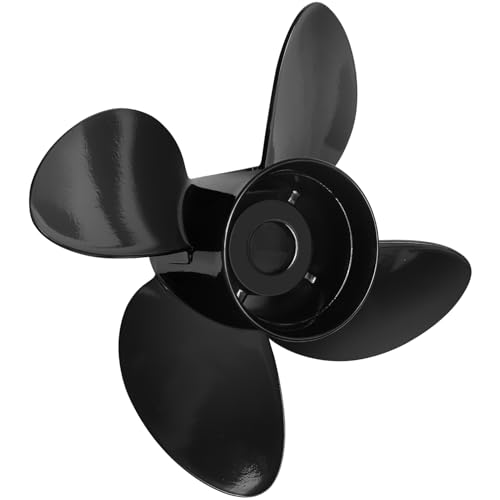
- Boat Outboard Propeller Spec:Diameter-14,Pitch-19,Rotation-Right,4-Blade Aluminum Propeller,Replaces…
- High quality: Our 14″x 19″ pitch outboard speed propeller for mercruiser alpha one is made by heavy…
- Function:Replaces original damaged 19 pitch Mercury/Mercruiser Alpha&Bravo I Stern-Drives…
Last update on 2026-04-09 / Affiliate links / Images from Amazon Product Advertising API