Will a Lantern on Shore Attract Fish at Night: Fishing Tips
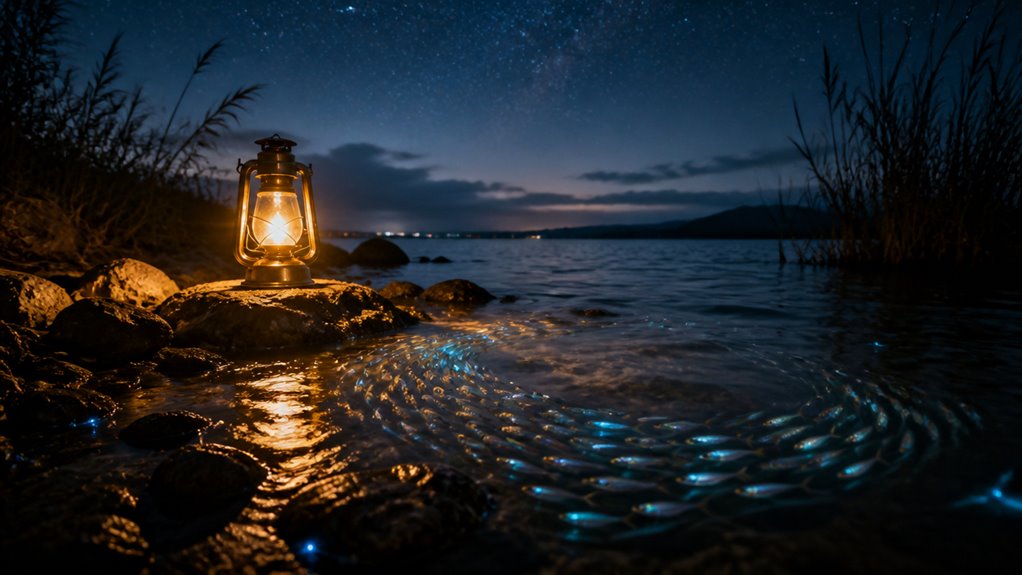
Yes, placing a lantern on shore can attract fish at night by illuminating water and initiating a feeding sequence.
Your light draws plankton, which lures baitfish like shad and minnows, eventually bringing in larger predators such as bass and catfish.
Green light is most effective, penetrating better with less disturbance.
Fish often respond within 20 minutes to a few hours, influenced by water conditions and habitat.
Understanding these factors helps you optimize your setup for success.
Key Takeaways
- Lantern light attracts plankton, which draws baitfish like shad and minnows closer to shore at night.
- Green light penetrates water efficiently and causes less disturbance, enhancing fish attraction near illuminated areas.
- Fish typically begin responding within 20 to 30 minutes, with larger game fish arriving 1 to 2 hours after sunset.
- Effectiveness depends on water depth, temperature, oxygen levels, current, and presence of underwater structures.
- Proper lantern placement and angle optimize illuminated zones, increasing fish aggregation and feeding activity near shore.
How Shore Lighting Attracts Fish at Night?
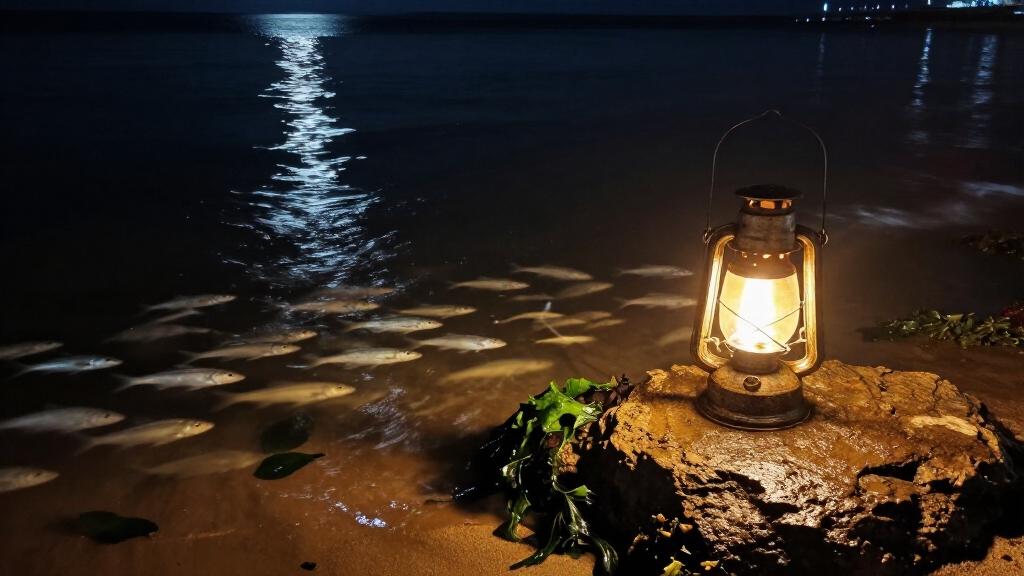
When you place a lantern on the shore at night, its light penetrates the water and attracts plankton and other tiny organisms. This initiates a feeding chain that draws in baitfish like shad and minnows.
Lantern light on shore draws plankton and tiny organisms, starting a feeding chain with baitfish.
These baitfish feed on the concentrated plankton near the illuminated area, creating a localized food source. Larger predatory fish then move closer, responding to the increased availability of prey.
The effectiveness of this process depends on factors such as light intensity, color, and placement relative to the water surface. Green light often penetrates water efficiently, enhancing attraction.
However, this chain reaction only occurs in waters that already support these organisms and fish populations. You should expect a time delay of 20 minutes to several hours before significant fish activity appears around the light. Additionally, fish tend to become more active near illuminated areas during conditions of low light penetration, which often coincide with safer feeding opportunities.
What Fish Respond to Shore Lighting?
Fish that respond to shore lighting typically include species that actively feed on plankton and smaller baitfish attracted by the illuminated area.
Plankton concentrations increase near the light, drawing baitfish such as shad and minnows, which then serve as prey for larger predatory fish.
You’ll often find species like bass, crappie, and catfish moving into these lit zones to exploit the feeding opportunities.
Green light frequently enhances this response because it penetrates water effectively, making it easier for baitfish and predators to locate the area.
However, the presence of these fish depends on existing populations and suitable habitat nearby.
Shore lighting doesn’t create fish populations but can concentrate those already present, especially where food chains are established and water conditions support active feeding behavior.
Using fishing lines with low memory and high sensitivity can improve bite detection when fishing near illuminated shorelines at night.
Environmental Conditions Affecting Shore Lighting
Although shore lighting can attract fish, its effectiveness heavily depends on specific environmental conditions such as water depth, temperature, oxygen levels, current, and the presence of underwater structures.
Shore lighting attracts fish only when environmental factors like depth, temperature, and structures align effectively.
In shallower water, light penetrates better, encouraging plankton growth and attracting baitfish. Warmer temperatures generally increase fish activity near the light, while low oxygen levels may cause fish to avoid the area altogether.
Current influences whether baitfish and predators hold position or drift away, affecting the feeding chain triggered by the light. Underwater structures like rocks or vegetation provide shelter and attract fish, improving the likelihood they’ll remain near the illuminated zone.
Without these conditions, a shore lantern’s light alone won’t create a productive fishing spot. Evaluating the environment is essential before relying on shore lighting.
Additionally, fish feeding activity often fluctuates with tidal phases, which can impact how effectively fish respond to shore lighting at night.
Why Green Light Works Best for Attracting Fish?
Understanding the effectiveness of green light in attracting fish involves examining its unique properties underwater. Green wavelengths penetrate water more efficiently than other visible colors, such as red or blue. This allows the light to reach greater depths and illuminate a larger area.
This enhanced penetration promotes the aggregation of plankton and baitfish, which are sensitive to green light. This sensitivity triggers a feeding response in predatory fish. Additionally, green light causes less disturbance compared to white or bright lights, reducing fish avoidance.
Its intermediate wavelength aligns well with the visual sensitivity of many freshwater and saltwater species. This improves detection and attraction. By using green light, you maximize the range and subtlety of illumination, enhancing the likelihood that fish will gather near the shore lantern without being spooked.
Because fish are more sensitive to shadows and movement than to color alone, the subtlety of green light further minimizes disturbance and increases attraction.
Best Ways to Place Your Lantern?
When setting up your lantern, think about where the light will have the most impact. You want that glow to reach productive water close to the shore, especially in those shallow areas where plankton and baitfish tend to hang out.
It’s all about getting the angle and distance just right. You want to create a nice, defined glowing zone without letting the light spread too far away from your fishing spot.
Don’t hesitate to experiment with different placements! Testing things out can really help you figure out what works best, especially when you consider local conditions like water depth and current.
Keep in mind that wind-driven currents concentrate plankton and baitfish, which can increase fish activity near your illuminated area, making wind-driven currents an important factor in lantern placement.
Happy fishing!
Optimal Lantern Positioning
Position your lantern so its light directly illuminates the water surface or shallow areas near the shore, maximizing visibility where fish are likely to gather.
Place the lantern close enough to the water’s edge to create a distinct illuminated zone that attracts plankton and baitfish, initiating the food-chain response.
Make sure the light penetrates productive water while avoiding excessive distance that weakens illumination.
Stability is essential; mount the lantern securely to prevent movement that might disturb fish.
Position it where it won’t cast shadows or glare that could deter aquatic organisms.
Minimize nearby noise and human activity to maintain natural behavior.
Additionally, consider the water temperature near the shore, as it significantly influences fish activity and their response to light.
Light Angle And Distance
Although the ideal placement varies by location, adjusting the angle and distance of your lantern relative to the water surface critically influences how effectively the light penetrates the water and attracts aquatic organisms.
Position your lantern so its beam grazes the water at a low angle, maximizing surface illumination without excessive reflection. Keep the lantern close enough to the shore to create a distinct glowing zone but avoid placing it too near to prevent disturbing fish with noise or shadows.
Consider these factors for best placement:
Angle the light to minimize glare and maximize underwater reach.
Maintain a distance that illuminates productive shallow zones.
Avoid direct overhead lighting that can spook fish.
Test incremental adjustments to find the best balance for local conditions.
This precise setup enhances the food-chain response triggered by your lantern. Additionally, understanding how trout feeding behavior changes during winter can help you optimize light placement to increase fish activity near your fishing spot.
How Long Fish Take to Respond to Shore Lighting?
Frequently, fish begin responding to shore lighting within 20 to 30 minutes after the light is activated.
However, this response time can extend to 1 to 2 hours after sunset for larger game fish to arrive. This delay occurs because the initial light attracts plankton, which then draws in baitfish, followed by predatory species.
You should expect smaller species like shad or minnows to appear sooner. Larger game fish require more time to detect and approach the illuminated area.
Environmental factors such as water temperature, oxygen levels, and current influence how quickly fish respond. Additionally, fish presence and habitat suitability affect timing.
Using devices with clear sonar technology can help anglers better understand fish movement patterns around illuminated shorelines.
What to Expect and When Shore Lighting Won’t Work?
While knowing when fish typically respond to shore lighting helps set expectations, it’s equally important to recognize situations where this method may fail. Shore lighting won’t work if the habitat lacks fish or if water conditions are unfavorable.
You should account for factors like depth, temperature, and oxygen levels, as these influence fish presence and activity. Additionally, excessive water flow or absence of underwater structure can prevent fish from holding near the light.
Consider these limiting scenarios:
- Murky water blocking light penetration
- Low oxygen levels reducing fish activity
- Strong currents dispersing plankton and baitfish
- Shorelines lacking nearby deep water or cover
Understanding these constraints helps you avoid ineffective setups and optimize your fishing strategy. Properly securing your fishing line with an Improved Clinch knot can also enhance your chances of success in these conditions.
Frequently Asked Questions
Can Using Multiple Lanterns Increase Fish Attraction at Night?
Using multiple lanterns can increase fish attraction at night if you position them to expand the illuminated area without causing excessive light overlap that might disrupt fish behavior.
You’ll want to make certain each lantern’s light penetrates productive water and maintains a natural feeding chain.
However, too much light or poorly arranged lanterns can deter fish. Experiment with spacing, angles, and light intensity to optimize attraction based on local conditions.
Does the Type of Lantern Power Source Affect Fish Attraction?
Think of your lantern’s power source like the engine fueling a ship. It drives the light’s strength and consistency.
The type of power source does affect fish attraction because it influences brightness and duration. A stable, high-output battery delivers steady illumination, enhancing plankton and baitfish gathering.
In contrast, weaker or inconsistent power dims the light, reducing effectiveness. So, pick a reliable power source to maintain prime light conditions for attracting fish.
Are There Safety Concerns With Using Lanterns Near Water at Night?
Yes, you should consider safety concerns when using lanterns near water at night.
Electrical lanterns risk shock if they contact water, so make certain they’re waterproof or elevated.
Battery-powered lanterns reduce this risk, but watch for leaks or corrosion.
Also, avoid placing lanterns where they can trip you or disturb wildlife.
Always use stable, secure placements and keep backup light sources ready in case of failure or emergencies.
How Does Moonlight or Ambient Light Affect Lantern Effectiveness?
Moonlight and ambient light can dim your lantern’s impact by competing for attention underwater, much like a spotlight struggling against daylight.
When the moon is bright, your lantern’s contrast lessens, reducing its ability to attract plankton and baitfish.
In darker conditions, your light stands out more, enhancing the food chain response.
Can Shore Lighting Attract Unwanted Species or Pests?
Yes, shore lighting can attract unwanted species or pests.
Insects like moths and mosquitoes are drawn to artificial light sources, which may increase their presence near your fishing spot.
Additionally, non-target aquatic organisms or nuisance fish might be attracted to the illuminated area, potentially disrupting your fishing.
You’ll want to weigh light placement and intensity to minimize these effects while maximizing fish attraction.
Can a Shore Lantern Really Help You Catch More Fish?
When you place a lantern on shore at night, you’re not just lighting up the darkness; you’re influencing fish behavior.
Scientific studies confirm that fish are drawn to specific wavelengths, especially green light, due to their visual sensitivity and feeding habits.
However, factors like water clarity and weather conditions can limit this effect.
So, while a shore lantern can attract fish, expect varied results and be prepared for times when it simply won’t work as hoped.