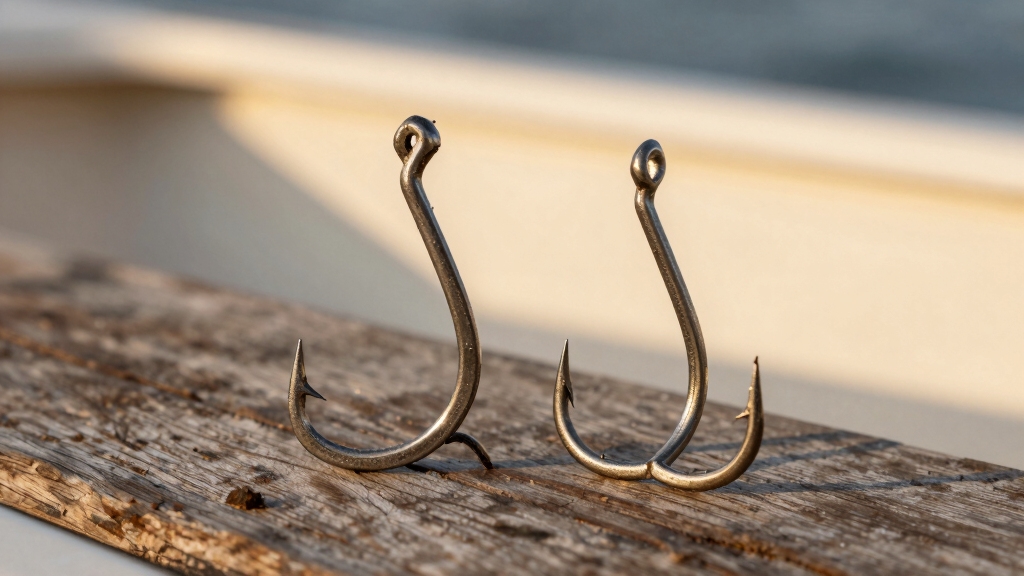
Kahle Hook vs Circle Hook: Which One Should You Use?
You’ll find Kahle hooks offer quick, deep penetration with an upward-pointing tip, making them ideal for active hook setting and live or chunk bait.
Circle hooks, by contrast, rotate during fish retrieval to hook the mouth corner. This reduces injury and promotes conservation through easier release.
While Kahle hooks suit precise control and firmer holds, circle hooks minimize gut hooking and internal damage.
Understanding these functional differences can help you optimize your fishing strategy effectively.
Key Takeaways
- Kahle hooks have an upward-pointing tip and wider gap, allowing easier baiting and deeper penetration similar to J-hooks.
- Circle hooks feature an inward-pointing tip that promotes mouth corner hooking and reduce gut hooking for conservation-focused fishing.
- Kahle hooks require active hook setting with a firm rod tip, while circle hooks rely on passive self-setting as the fish turns.
- Circle hooks minimize internal injury and improve catch-and-release survival, whereas Kahle hooks increase the risk of deeper hooking and injury.
- Choosing between Kahle and circle hooks depends on fishing goals: active control and deeper sets versus minimal injury and better fish survival.
Kahle Hook or Circle Hook: Comparison Table
| Feature | Kahle Hook | Circle Hook |
|---|---|---|
| Tip Orientation | Slightly upward-pointing tip | Inward-pointing tip (perpendicular to shaft) |
| Hook Shape | Wider gap, open design (similar to J-hook) | Circular shape with curved-in point |
| Hooking Mechanism | Requires active hook set (rod lift) | Self-sets as fish turns (no striking needed) |
| Hooking Depth | Deeper penetration (often gut or throat) | Shallow penetration (mouth corner) |
| Hooking Location | Gut, throat, or deep mouth | Mostly corner of the mouth |
| Fish Injury Risk | Higher (due to deep hooking) | Lower (minimal internal damage) |
| Catch & Release Suitability | Less ideal | Highly recommended |
| Baiting Ease | Easier to bait (live/chunk bait friendly) | Slightly harder due to inward tip |
| Fishing Style | Active fishing (hands-on control) | Passive fishing (let fish set hook) |
| Hook Set Control | High control by angler | Minimal control (relies on fish movement) |
| Hook Holding Strength | Strong, firm hold due to deep penetration | Secure hold in mouth corner |
| Best Use Case | Live bait fishing, aggressive strikes | Conservation, catch-and-release fishing |
| Gut Hooking Risk | Higher | Very low |
| Fish Survival Rate | Lower (more injury) | Higher (less stress and damage) |
| Skill Requirement | Requires timing and technique | Beginner-friendly, less effort needed |
How Kahle and Circle Hooks Differ in Design and Shape?
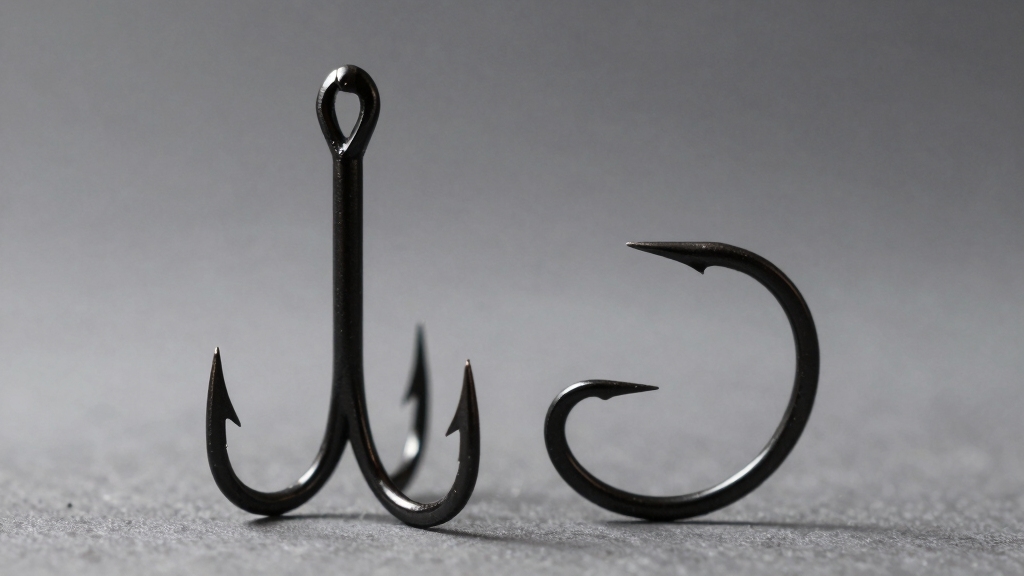
When comparing Kahle and Circle hooks, their distinct design and shape differences directly influence their fishing performance.
Circle hooks feature a wide gap with a sharply inward-pointed tip oriented nearly perpendicular to the shaft. This design optimizes them to minimize gut hooking and facilitate catch-and-release.
In contrast, Kahle hooks have tips angled slightly upward, increasing the distance from the shaft. This allows for deeper penetration and effective hooking with live bait.
This tip orientation classifies Kahle hooks as live bait hooks, while circle hooks focus on conservation by reducing internal injury.
The design variations impact bait presentation and hooking depth, with Kahle hooks typically penetrating deeper than circle hooks.
Understanding these structural nuances enables you to select the appropriate hook type based on your fishing goals and techniques.
Additionally, just as the choice between Snell and Palomar knots depends on fishing style and conditions, selecting the right hook benefits from considering factors like bait presentation and hooking effectiveness in specific environments, highlighting the importance of hook presentation.
How Kahle and Circle Hooks Catch Fish Differently?
You know, the way Kahle and Circle hooks are designed really affects how they catch fish. With their unique shapes, these hooks behave quite differently when you’re reeling in a catch.
Kahle hooks, for instance, often go in deeper, which can sometimes mean they hook fish in the gut. On the other hand, Circle hooks have this cool rotation feature, allowing them to secure a hookset mostly in the fish’s mouth.
Circle hooks are also favored for their ability to reduce gut hooking and improve catch-and-release survival.
Hook Design Impact
Understanding how Kahle and Circle hooks catch fish differently hinges on their distinct design features and hooking mechanisms.
You’ll notice Circle hooks have a wide gap and inward-pointing tip that slides out of the fish’s mouth as it turns, reducing gut hooking.
Kahle hooks feature an upward-pointing tip, enabling deeper penetration similar to J-hooks, which results in more secure but deeper hooking.
| Hook Type | Hooking Behavior |
|---|---|
| Circle Hook | Rotates out of mouth, shallow |
| Kahle Hook | Penetrates deeper, holds firm |
| Impact | Circle: minimal damage, Kahle: deeper set |
These differences affect your fishing strategy and conservation approach, balancing effective hook sets with fish survival. Barbless hooks, often used with designs like Circle hooks, reduce injury severity and handling time, promoting better post-release survival through reduced tissue damage.
Penetration And Rotation
The distinct hooking behaviors of Kahle and Circle hooks directly influence their penetration and rotation dynamics during a catch. When you use a Kahle hook, its upward-pointing tip penetrates quickly, resembling a J-hook’s action. This allows deeper gut hooking.
You actively set the hook by lifting the rod tip, which drives the point into the fish efficiently. In contrast, Circle hooks rely on the fish swallowing the bait fully. As the fish turns, the hook naturally rotates toward the corner of the mouth, minimizing deep penetration.
You don’t need to strike with Circle hooks, as their inward-pointing tip and shape promote a self-setting mechanism during rotation. This difference affects your approach, with Kahle hooks requiring active setting and Circle hooks depending on natural rotation for effective penetration. Understanding how material stiffness influences hook behavior can further optimize your fishing technique.
Fish Hooking Locations
Typically, Kahle and Circle hooks catch fish in distinctly different locations due to their design and hooking mechanisms.
Circle hooks position the point inward and perpendicular to the shaft. This allows the hook to rotate and catch the fish in the corner of the mouth as the fish turns.
This reduces gut hooking and facilitates easier release. Kahle hooks, with their upward-pointing tip and greater gap, penetrate deeper, often hooking fish in the throat or gut.
This deeper hooking results from their ability to penetrate more readily, similar to J-hooks. This makes Kahle hooks suitable for active hook setting.
While Kahle hooks increase the risk of deeper injury, they provide more secure hooksets. You should choose based on your fishing goals: use Circle hooks for conservation and catch-and-release, and Kahle hooks for deeper penetration and active fishing techniques.
Choosing hooks like Circle hooks that reduce tissue damage aligns with angler practices aimed at minimizing injury and environmental impact.
How Hook Design Affects Hooking Depth and Location?
You’ll notice that the tip orientation really plays a big role in where and how deep the hook sets in a fish.
Take Kahle hooks, for example. Their upward-pointing tips often lead to deeper penetration, which can sometimes result in gut hooking.
On the other hand, circle hooks are a bit different.
With their inward-pointing tips, they tend to hook the fish in the corner of the mouth instead. This design reduces the chances of deep penetration, which is definitely a plus for catch and release.
Choosing the appropriate hook size and strength ensures effective hooking while minimizing harm to the fish.
Tip Orientation Impact
Hook tip orientation directly influences how deeply and where a fish gets hooked during a strike.
With circle hooks, the inward-pointed tip aligns nearly perpendicular to the shaft. This encourages the hook to rotate toward the fish’s jaw as it turns, resulting in consistent mouth hooking with minimal gut penetration.
Conversely, Kahle hooks feature a tip that points slightly upward, increasing the distance from the shaft. This orientation allows the hook to penetrate more aggressively and deeply, often lodging within the fish’s throat or gut.
You’ll notice Kahle hooks behave similarly to J-hooks in their immediate penetration, enabling quicker hook sets. Understanding these differences helps you select a hook that balances effective hooking depth with fish preservation goals. This is important depending on whether you prioritize catch-and-release or active retrieval strategies.
Additionally, selecting the proper hook size and design can significantly influence hooking success and bait presentation, similar to how different rigs like the Jika and Tokyo rigs are tailored for specific fishing conditions.
Hooking Location Differences
The differing tip orientations of Kahle and circle hooks directly influence where and how deeply a fish is secured during a strike. Kahle hooks, with their upward-pointing tip, penetrate more deeply, often hooking fish in the gut. Circle hooks, featuring an inward-pointing tip, secure fish mostly in the mouth corner, reducing gut hooking and damage.
| Aspect | Kahle Hook | Circle Hook |
|---|---|---|
| Tip Orientation | Slightly upward | Inward, perpendicular |
| Hooking Depth | Deeper gut hooking | Shallow mouth hooking |
| Fish Damage Risk | Higher (deeper penetration) | Lower (minimal gut hooking) |
| Hook Set Method | Active (rod tip set) | Passive (fish turns to set hook) |
Choosing the right hook type, much like selecting proper knots such as the Blood Knot or Double Uni, depends on your specific fishing conditions and desired outcomes.
Why Circle Hooks Are Best for Catch-and-Release Fishing?
Prioritizing fish survival during catch-and-release fishing often means selecting gear that minimizes internal injury, which is where circle hooks excel.
Choosing gear that reduces injury is key to fish survival in catch-and-release fishing, and circle hooks deliver.
Their inward-pointing tip and wide gap design cause the hook to slide out of the fish’s esophagus and catch firmly in the mouth corner, reducing gut hooking.
This mechanism lowers the risk of deep penetration and internal bleeding, preserving fish health.
Unlike Kahle hooks, which tend to hook deeper and cause increased injury, circle hooks facilitate easier hook removal.
This minimizes handling time and stress.
By reducing mortality rates associated with gut hooking, circle hooks promote sustainable fishing practices and population conservation.
When you choose circle hooks, you enhance fish survival chances, making them the preferred option for catch-and-release anglers focused on conservation and ethical fishing techniques.
Proper use of circle hooks combined with minimized air exposure further improves post-release survival by reducing physiological stress.
Choosing Kahle Hooks for Active Fishing Styles
When engaging in active fishing styles, Kahle hooks offer distinct advantages due to their design and functionality. Their upward-pointing tip and open gap allow you to set the hook manually, giving you control to respond quickly to fish strikes.
Unlike circle hooks, Kahle hooks penetrate deeply like J-hooks, increasing your hookup rate during active fishing. You’ll find them versatile across various rods, particularly spinning rods, where you can choose to set the hook or let the fish run.
Here’s why Kahle hooks suit active fishing:
- They enable immediate hook setting with rod tip movement.
- Their design guarantees deeper penetration, improving hold during fights.
- They maintain low gut hook incidence despite deeper hooking.
These features make Kahle hooks ideal when you fish actively and want precise hook control. Additionally, selecting the proper hook size to match your bait ensures optimal penetration and natural bait movement.
Why Kahle Hooks Are Easier to Bait With Live or Chunk Bait?
Building on their suitability for active fishing, Kahle hooks also simplify baiting, especially with live or chunk bait.
Their tip points slightly upward and away from the shaft, creating a wider gap that provides ample space to securely thread live or chunk bait without damaging it.
The upward-angled tip and wider gap make threading live or chunk bait easier and safer.
This design reduces bait slippage during casting or retrieval, maintaining bait integrity longer.
Unlike circle hooks, whose inward-pointing tip can complicate bait placement, Kahle hooks allow you to present bait naturally, improving attraction and hook-up rates.
The open hook face lets you position bait quickly and adjust it as needed.
This ease of baiting enhances efficiency during active fishing, where rapid hook sets and bait adjustments are essential for success.
How Circle Hooks Help Prevent Gut Hooking and Fish Injury?
Circle hooks consistently reduce gut hooking by their unique design, which causes the hook to rotate and exit the fish’s mouth rather than penetrating the stomach.
When you use a circle hook, its inward-pointing tip and wide gap guarantee the hook sets in the corner of the fish’s mouth during retrieval.
This mechanism minimizes internal injury, improving fish survival rates.
Here’s how circle hooks help prevent gut hooking and fish injury:
- The hook’s shape promotes rotation during the fish’s turn, preventing deep stomach penetration.
- Mouth hooking reduces bleeding and tissue damage, facilitating easier hook removal.
- Circle hooks support catch-and-release practices by maintaining fish health and population sustainability.
Best Fishing Techniques for Kahle and Circle Hooks
Although Kahle and circle hooks both excel in hooking efficiency, each demands distinct fishing techniques to maximize their effectiveness.
When using Kahle hooks, you’ll benefit from active fishing. Keep your rod in hand and be ready to set the hook with a firm rod tip lift. This approach leverages the Kahle’s upward-pointing tip for deeper penetration.
In contrast, circle hooks work best with passive setups. Use spiked rods or bait casters, allowing the fish to swallow the bait fully. Don’t strike immediately; let the fish turn, causing the hook to rotate and catch in the mouth. This reduces gut hooking.
Both hooks require sharpness to guarantee penetration, but your technique must adapt. Use active hook setting for Kahle hooks and patient, hands-off retrieval for circle hooks.
Kahle vs Circle Hooks: Key Advantages for Anglers
When choosing between Kahle and circle hooks, understanding their specific advantages can help you optimize your fishing strategy.
Choosing between Kahle and circle hooks hinges on knowing their unique benefits for better fishing results.
Kahle hooks offer easier baiting and allow you to actively set the hook for quicker response. This makes them ideal for live or chunk bait.
Circle hooks excel in minimizing gut hooking, promoting fish survival and conservation, especially during catch-and-release.
Both hooks perform effectively when sharp but suit different fishing techniques.
Key advantages include:
- Kahle hooks provide deeper penetration and versatile use across rod types with low gut hook incidence despite their design.
- Circle hooks reduce stomach hooking markedly, preserving fish populations and easing hook removal.
- Kahle hooks enable active hook sets, while circle hooks work best with passive setups or spiked rods.
Frequently Asked Questions
What Materials Are Kahle and Circle Hooks Typically Made From?
You’ll find Kahle and circle hooks typically made from high-carbon steel or stainless steel to guarantee strength and corrosion resistance.
These materials endure harsh saltwater and freshwater environments, maintaining sharpness and durability.
Some hooks feature nickel or black nickel plating for extra protection and reduced visibility underwater.
The choice of material impacts hook longevity and performance, so you should select hooks based on fishing conditions and target species for peak results.
Can Kahle and Circle Hooks Be Used for Saltwater Fishing?
Yes, you can use both Kahle and circle hooks for saltwater fishing. They’re typically made from corrosion-resistant materials like stainless steel or high-carbon steel with protective coatings, ensuring durability in harsh saltwater environments.
Kahle hooks suit active fishing styles, while circle hooks excel in passive setups. Just remember to rinse your gear after use to prolong hook life and maintain sharpness for effective penetration and reliable hook sets in saltwater conditions.
How Do Hook Sizes Compare Between Kahle and Circle Hooks?
You’ll find Kahle hooks generally run slightly larger than circle hooks at the same nominal size.
This is because Kahle hooks have an upward-pointing tip and wider gape, requiring more metal.
When selecting sizes, expect to use a Kahle hook one or two sizes smaller than a circle hook to match gape and bait presentation.
Always check specific manufacturer sizing charts, as dimensions can vary between brands and models.
Are There Specific Fish Species Better Suited for Each Hook Type?
You’ll find circle hooks excel with species where catch-and-release is common, like snapper, tarpon, and striped bass, thanks to their mouth-hooking design.
Kahle hooks suit species that require deeper penetration, such as catfish or larger live bait feeders, where active hook setting is preferred.
Kahle hooks accommodate live bait better and work well with species that strike aggressively.
Circle hooks are ideal for conservation-minded fishing targeting species sensitive to gut hooking.
What Are the Best Knot Types for Securing Kahle and Circle Hooks?
When securing Kahle or Circle hooks, the Improved Clinch Knot and Palomar Knot stand out as your best allies. They grip like a vice, ensuring no slip.
The Improved Clinch Knot threads smoothly, perfect for monofilament. The Palomar offers superior strength for braided lines.
Both knots maintain the hook’s orientation, preserving the subtle angles essential for effective penetration and rotation. Your setup stays battle-ready with minimal line damage.
Precision in Every Catch: Picking the Perfect Hook
When choosing between Kahle and circle hooks, understanding their subtle design nuances can markedly refine your fishing approach.
Circle hooks gently encourage a secure catch with minimal stress on the fish, making them ideal for conservation-minded anglers. Meanwhile, Kahle hooks offer versatile baiting options and active hooking, catering to more dynamic fishing styles.
By selecting the right hook, you’re not just improving your catch rate but also promoting a more thoughtful, fish-friendly angling experience.